

A functional health framework for safer cardiovascular decisions
Executive Summary
The question is not whether statins are good or bad. The useful question is whether the biological conditions that made lipid-lowering treatment necessary have changed enough to justify a different medical strategy. Statins reduce exposure to atherogenic particles and lower cardiovascular events, particularly when a person already has plaque, a previous heart attack, a stent, a stroke or another form of established atherosclerotic cardiovascular disease. In those settings, the evidence for continuing effective lipid-lowering protection is strong, and the threshold for reducing it is high.[1]
At the same time, cardiovascular risk is not created by one cholesterol number. Atherosclerosis develops when apolipoprotein B-containing particles repeatedly enter and become retained within a vulnerable artery wall. Blood pressure, insulin resistance, glucose exposure, smoking, kidney disease, inherited lipoprotein(a), inflammation, oxidative stress and time influence how readily that process advances. Plaque then becomes dangerous when inflammation, failed cellular clean-up and fibrous-cap breakdown outweigh repair, allowing rupture or erosion to trigger a blood clot. Plasma fibrinogen is associated with clotting and vascular events, although it is not a stand-alone treatment target.[2-7]
A functional health approach therefore expands the operating map. It asks whether particle burden, fuel handling, inflammation, organ function, vascular pressure, plaque status, clotting tendency, sleep, muscle and recovery are moving in a safer direction together. This wider map prevents two common errors: assuming that good treated lipids prove repaired biology, or assuming that excellent glucose and inflammation markers make high ApoB irrelevant. Both conclusions go beyond the evidence.
The practical process is sequential. First, clarify why treatment was prescribed and whether the person is in primary or secondary prevention. Next, establish a stable baseline while medication and lifestyle are unchanged. Then improve nutrition, movement, muscle, sleep, stress regulation, oral and gut health, smoking and alcohol exposure, and any identified thyroid, liver or kidney contributors. After the new pattern has been sustained, retest. Only then should the cardiologist consider whether the safest outcome is continued treatment, a lower dose, a different statin, combination therapy, a non-statin option or, in selected lower-risk cases, supervised withdrawal.[1,8-12]
Emerging research on metabolically healthy people following ketogenic diets is scientifically important but not yet sufficient to overturn the established relationship between ApoB exposure and atherosclerosis. A 2024 cross-sectional matched study found similar plaque burden in a selected ketogenic cohort despite much higher LDL cholesterol, but it could not establish progression, long-term safety or event risk. The subsequent longitudinal KETO-CTA paper was retracted in 2026 because methodological errors were considered too serious to correct. Therefore, low insulin, low triglycerides, high HDL cholesterol, low hsCRP and a flat continuous-glucose-monitor trace are favourable findings, but they do not currently prove that high ApoB is harmless.[13-16]
The best outcome is not being medication-free. It is safer biology: fewer artery-entering particles, a calmer artery wall, stronger metabolic function, lower clotting pressure, preserved muscle and recovery, and a medical plan the person understands and can sustain. Functional coaching can help turn a complex pattern into a measured plan while remaining inside ethical boundaries and alongside medical care.
1. Begin With the Risk Decision, Not the Drug
A statin prescription is a risk-control decision. The doctor is not treating the word “cholesterol”; the doctor is reducing the probability that plaque will progress, destabilise and produce a heart attack or stroke. The 2026 multisociety dyslipidaemia guideline now frames risk more explicitly around lifelong exposure to atherogenic lipoproteins, including remnants and lipoprotein(a), while retaining LDL cholesterol and non-HDL cholesterol goals and selective ApoB measurement. The higher the proven risk, the stronger the recommended protection.[1]
Primary prevention means preventing a first cardiovascular event. Secondary prevention means the body has already demonstrated event-capable vascular disease through a heart attack, stent, stroke, transient ischaemic attack, bypass operation, peripheral artery disease or proven coronary plaque. In secondary prevention, the question is rarely whether medication is personally desirable. It is which combination of treatment and functional improvement produces the lowest residual risk with the best tolerance.
This distinction creates necessary humility. Feeling well does not prove vascular safety, because plaque can progress silently. A clean diet does not prove low ApoB. A low hsCRP does not remove particle exposure. Equally, a low LDL cholesterol result on treatment does not prove that insulin resistance, blood pressure, visceral fat, poor sleep or inflammation have resolved. The whole pattern must be measured before the treatment strategy is reconsidered.
2. Atherosclerosis: Particle Exposure Meets a Vulnerable Artery Wall
Fat and cholesterol cannot travel freely in blood, so the body packages them into lipoproteins. After a meal, the intestine releases chylomicrons. The liver releases very-low-density lipoprotein, or VLDL, which can lose triglyceride and become intermediate-density lipoprotein and then LDL. These particles perform essential transport work. Cholesterol is also essential for cell membranes, hormones, bile acids and repair. The problem is not that cholesterol or ApoB exists. The problem is repeated exposure to more artery-entering particles than the body can safely clear over time.
Each major atherogenic particle carries one ApoB molecule. Therefore, ApoB is a practical estimate of particle number. LDL cholesterol (LDL-C) measures cholesterol carried inside LDL; non-HDL cholesterol (non-HDL-C) measures cholesterol carried across all atherogenic particles; triglycerides show part of the liver’s fuel-export pattern; and lipoprotein(a), or Lp(a), identifies a mainly inherited particle that can increase atherosclerotic, inflammatory and thrombotic risk. When LDL-C and ApoB disagree, studies show that risk tends to follow ApoB more closely because the artery encounters particles one by one.[2-4,17]
Not every ApoB particle enters the artery wall, and particles are not identical. Smaller, cholesterol-poor LDL particles can be common in insulin resistance and may remain in circulation longer or be more susceptible to modification. Oxidised LDL is LDL that has been chemically altered, often after retention within the artery wall. Nevertheless, specialised small-dense-LDL and oxidised-LDL tests have not replaced ApoB, non-HDL-C, standard lipids, risk history and imaging in clinical decision-making. A useful interpretation is that every ApoB particle creates an opportunity for retention, while the arterial terrain determines how readily that opportunity becomes disease.
The endothelium is the living inner lining of the artery. When healthy, it produces nitric oxide, keeps the vessel relaxed and reduces unwanted adhesion. High blood pressure, smoking, glucose exposure, insulin resistance, kidney disease, systemic inflammation, disturbed sleep and oxidative stress can reduce that protection. The lining becomes more permeable and adhesive. ApoB particles then cross into the inner arterial layer, bind to the local matrix and become retained. This retention is the initiating event in the accepted response-to-retention model of atherosclerosis.[2]
Once retained, particles can be oxidised or glycated. Glycation means that glucose attaches to proteins or lipids without normal enzymatic control, altering their behaviour. Oxidation means reactive molecules chemically damage the particle. The immune system responds by sending monocytes into the artery wall; these become macrophages and ingest modified lipids. When overloaded, they become foam cells. What began as repair becomes persistent inflammation, cell death and plaque growth.
3. Why Some Plaques Stabilise and Others Rupture
The plaque pathway is a balance between damage and resolution. On one side are pro-inflammatory signals, continued particle entry, cell death and enzymes that weaken the plaque structure. On the other side are efficient cellular clean-up, pro-resolving signals and the construction of a strong fibrous cap. The image below captures this balance: when inflammation and necrosis dominate, the plaque develops a soft core and a thin, fragile cover; when clean-up and healing dominate, the cap becomes thicker and the plaque is more stable.
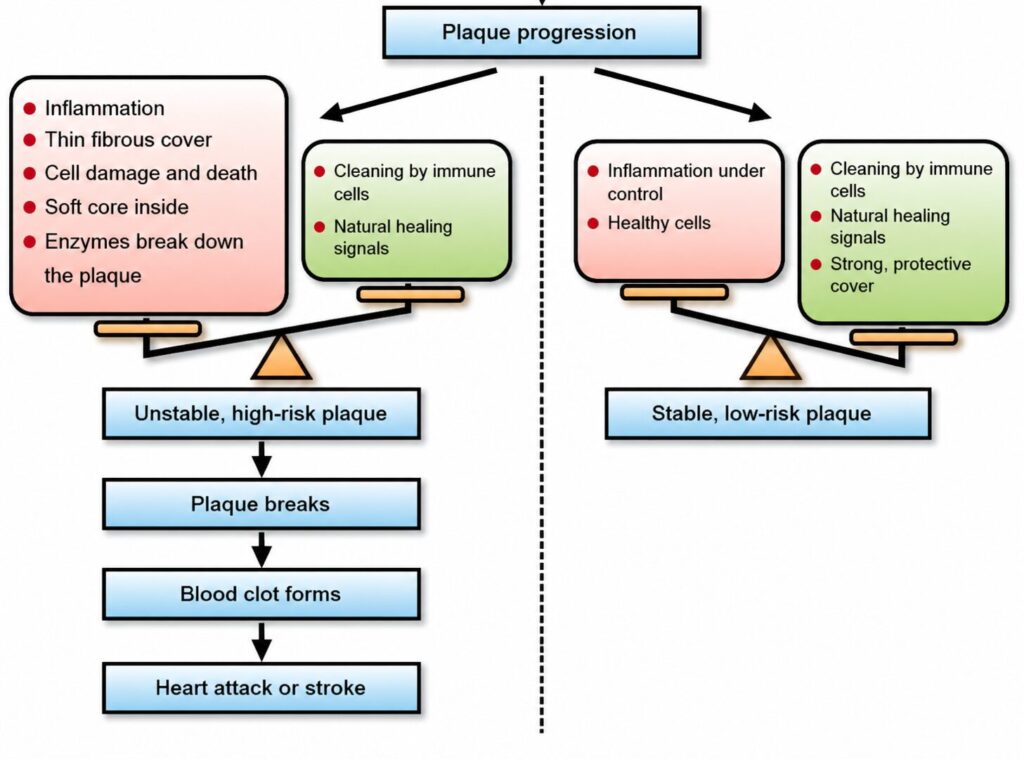
A central repair process is efferocytosis, which means that macrophages remove dead and dying cells before their contents spill into the plaque. Experimental and human plaque research links defective efferocytosis with larger necrotic cores, thinner caps and symptomatic disease. Conversely, effective clean-up and pro-resolving lipid mediators support a more stable plaque structure.[6] This biology explains why reducing inflammation matters, but it also sets a boundary: low inflammation does not erase retained particles or established plaque.
The CANTOS trial provided clinical proof that inflammation is not merely a bystander. In people with previous myocardial infarction and persistent inflammation, targeted inhibition of interleukin-1 beta reduced recurrent cardiovascular events without lowering lipids, although it increased fatal infection and did not reduce all-cause mortality.[5] The lesson is not that inflammation should replace lipid management. It is that residual inflammatory risk and residual lipid risk are distinct and can coexist.
Most acute events occur when a plaque ruptures or erodes and the blood forms a clot. Fibrinogen is a circulating protein converted into fibrin, the mesh that stabilises a clot. Large prospective data show that higher usual fibrinogen levels are associated with coronary disease and stroke even after adjustment for conventional risk factors, but causal relevance and treatment thresholds remain uncertain.[7] Therefore, fibrinogen can add context when clinically appropriate, especially alongside inflammation, smoking, metabolic disease and thrombotic history, but it is not a stand-alone licence to change medication.
4. What Statins Change—and What They Do Not
Statins inhibit cholesterol synthesis in the liver. The liver responds by increasing LDL receptors, which remove more ApoB-containing particles from the circulation. This lowers LDL cholesterol, non-HDL cholesterol and usually ApoB exposure. Statins also reduce inflammatory signalling in many people and promote plaque stability. Randomised trials and the 2026 guideline show that lowering atherogenic lipoproteins reduces cardiovascular events, with the largest absolute benefit in people at highest baseline risk.[1,9,10]
The medication effect is therefore real protection, not a cosmetic improvement in a laboratory report. Adding ezetimibe after acute coronary syndrome reduced events beyond statin therapy by decreasing intestinal cholesterol absorption. PCSK9 inhibition produced much larger LDL reductions and lowered events in established cardiovascular disease. Bempedoic acid reduced events in statin-intolerant high-risk patients, although it has its own adverse-effect profile. These options show that the medical question is not simply “statin or no statin”; it is the safest lipid-lowering design for the person’s risk and tolerance.[9-11]
However, medication does not automatically rebuild the full biological terrain. A person can have low treated LDL cholesterol while retaining high blood pressure, insulin resistance, liver fat, visceral fat, poor sleep, low muscle mass, smoking exposure, periodontal inflammation or kidney dysfunction. In that situation one important window is closed, while other pathways continue to place pressure on the artery wall. Functional health works on those upstream conditions, but it must not confuse broader improvement with proof that particle-lowering protection is no longer needed.
5. The Pre-Review Systems Map
Before medication is reviewed, the aim is to build a stable evidence base.
- The first layer is particle traffic: ApoB, LDL cholesterol, non-HDL cholesterol, triglycerides and Lp(a). ApoB estimates particle number; non-HDL cholesterol captures cholesterol across the atherogenic particles; triglycerides and remnant patterns help identify fuel overflow; and Lp(a) identifies inherited risk. The result must be interpreted against the original untreated values, family history, duration of exposure and any known plaque.
- The second layer is fuel handling. Fasting glucose and HbA1c show glucose exposure, while fasting insulin can provide additional functional context before glucose becomes abnormal. Waist-to-height ratio, liver enzymes and triglycerides can indicate visceral and liver fuel overload. Continuous glucose monitoring can reveal meal responses and variability, but a flat trace is not a validated substitute for ApoB, blood pressure, imaging or clinical risk classification.
- The third layer is inflammation and oxidative pressure. High-sensitivity C-reactive protein, or hsCRP, is a useful systemic signal when measured away from infection, injury and intense exercise. A value below 1 mg/L is generally favourable, but very low hsCRP does not prove that plaque is absent or that high ApoB is harmless. Ferritin must be read in context because it can reflect iron stores, inflammation, liver stress or metabolic disease. Homocysteine can identify nutritional, thyroid or kidney-related problems, but lowering it has not consistently translated into fewer coronary events, so it should not be treated as an isolated cardiovascular target.
- The fourth layer is organ function. The liver produces and clears lipoproteins. The thyroid influences LDL-receptor activity and lipid clearance. Kidney disease independently increases vascular risk and changes medication and supplement safety. Albumin, liver enzymes, estimated glomerular filtration rate and urine albumin can therefore reveal secondary contributors that need medical investigation before any functional plan is intensified.
- The fifth layer is vessel and plaque status. Home blood pressure gives a more reliable pattern than one clinic reading. Pulse pressure can add context about arterial stiffness. Coronary artery calcium, or CAC, identifies calcified plaque and can reclassify primary-prevention risk. Coronary CT angiography, or CCTA, can show both calcified and non-calcified plaque, although it involves radiation, contrast and measurement limitations and is not a routine short-interval tracking tool for everyone. A previous event or established plaque weighs more heavily than any single favourable metabolic marker.
- The sixth layer is clotting context. Fibrinogen, platelet findings, smoking, inflammatory disease and personal or family thrombotic history can influence the likelihood that plaque disruption becomes an occlusive clot. These findings require medical interpretation because clotting is a complex system and indiscriminate testing or supplementation can mislead.
- The final layer is recovery capacity. Sleep, symptoms, exercise tolerance, muscle mass and training response show whether the person can adapt to the plan. Heart-rate variability may help track personal recovery trends, but it is not a cardiovascular diagnostic test and should never determine medication changes. The safest interpretation uses trends across the network, not one exceptional number.
6. Rebuilding the Terrain Before Review
- The intervention begins with food architecture rather than a universal diet label. The goals are to reduce energy overflow, preserve muscle, improve glucose and insulin handling, support bowel and bile clearance, and avoid a dietary pattern that raises ApoB unnecessarily. Adequate protein supports muscle and satiety. Soluble fibre can lower LDL cholesterol and improve glycaemic control. Replacing excess saturated fat with extra-virgin olive oil, nuts, seeds and fish often improves the lipid response. A Mediterranean dietary pattern supplemented with olive oil or nuts reduced major cardiovascular events in a large randomised primary-prevention trial.[8]
- Carbohydrate restriction can be valuable when insulin resistance, high triglycerides, liver fat, diabetes or large glucose excursions are dominant. However, low carbohydrate is not synonymous with unlimited saturated fat. Controlled feeding studies show that carbohydrate reduction can improve triglycerides, ApoB and small-LDL patterns when saturated fat is moderate, while a very-low-carbohydrate, high-fat diet can raise LDL cholesterol substantially and unpredictably in lean healthy adults.[14,15] Therefore, the body’s measured response—not dietary ideology—must decide the design.
- Movement is the next lever. Muscle is a major destination for glucose, so resistance training improves metabolic capacity and protects future independence. Walking after meals reduces post-meal glucose exposure, while aerobic training supports blood pressure, endothelial function and cardiorespiratory fitness. The dose must match recovery. Overtraining, poor sleep and inadequate nutrition can increase inflammatory signals and undermine adherence, so the objective is repeatable adaptation rather than exhaustion.
- Sleep and nervous-system regulation are not optional wellness additions. Poor sleep raises sympathetic drive, blood pressure, appetite and glucose output. Breath practice, stable sleep timing, morning light, reduced late stimulation and appropriate recovery can lower the biological pressure that keeps vessels constricted and metabolism defensive. Oral health, smoking, pollution exposure, alcohol and gut symptoms also need attention because persistent inflammatory inputs can remain active even when the diet appears clean.
- Supplements come after the pattern is understood. Omega-3 fatty acids, magnesium, vitamin D, fibre or specific B vitamins may be appropriate when diet, symptoms, laboratory data and medical context support them. They should not be used to replace proven lipid-lowering treatment, and some interact with anticoagulants, blood-pressure medication, kidney function or other therapies. Precision means choosing only what has a defined purpose, a safe dose and a measurable outcome.
7. From Better Biology to a Supervised Medication Review
A safe review follows a fixed sequence.
- Map the original indication: primary or secondary prevention, untreated lipid values, family history, plaque burden, Lp(a), diabetes, kidney disease and prior events.
- Measure the baseline while medication and lifestyle are stable.
- Implement the functional plan and sustain it long enough for the body to reach a new steady state. Short bursts of perfect behaviour do not establish durable risk reduction.
- Take the evidence to the treating doctor. The doctor decides whether the risk category permits a change. For a person with previous myocardial infarction, stent or proven plaque, complete withdrawal is rarely the first objective. A lower statin dose, a different statin, alternate dosing, ezetimibe, bempedoic acid, a PCSK9-based therapy or combination treatment may preserve protection with better tolerance. The 2026 guideline explicitly positions non-statin therapies as standard components of care when additional lowering or improved tolerability is needed.[1]
- If a change is approved, treat it as a controlled test. Agree what will change, when lipids and other markers will be repeated, which symptoms require review and which thresholds end the experiment. Statins do not require physiological “weaning” in the way some drugs do; the issue is not withdrawal symptoms but the return of particle exposure when treatment pressure is removed. Therefore, dose reduction or discontinuation must be described accurately and monitored promptly.
- Finally, retest and accept the answer. If ApoB, non-HDL cholesterol, blood pressure, glucose, inflammation or symptoms move in the wrong direction, the plan changes. If risk remains well controlled, the doctor may maintain the new strategy. Observational evidence generally links statin discontinuation outside end-of-life care with worse cardiovascular outcomes, although confounding limits certainty. That is another reason why self-directed stopping is unsafe and why the outcome must remain open.[12]
8. Ketogenic Diets, High LDL and the Current Evidence Boundary
Nutritional ketosis can produce major improvements in glucose, insulin, triglycerides, appetite and body composition in selected people. It can also raise LDL cholesterol and ApoB, sometimes dramatically, particularly in lean people with low triglycerides and high HDL cholesterol. The crucial scientific question is whether excellent metabolic health substantially modifies the long-term risk created by high particle exposure.
A 2024 cross-sectional matched study compared 80 people following a ketogenic diet with LDL cholesterol of at least 190 mg/dL against 80 matched participants with much lower LDL cholesterol. The ketogenic group did not have more plaque at the single measured time point. However, the groups differed in body mass index and metabolic phenotype, the study was observational, and it could not show what happened before the diet, how plaque changed over time or whether cardiovascular events differed.[13] It is hypothesis-generating, not proof of safety.
The later one-year KETO-CTA progression paper reported that ApoB was not associated with plaque change, but the journal retracted it in May 2026 after methodological concerns were judged too serious to correct.[16] It must therefore not be used to claim that ApoB does not matter in metabolically healthy ketosis. The retraction is also a useful coaching lesson: emerging evidence can be exciting, but decisions should not run ahead of reliable methods and replicated outcomes.
My own experience remains personally meaningful but scientifically limited. After a heart attack and two stents, I followed nutritional ketosis for about two years and recorded fasting insulin around 2 micro-international units per millilitre, fasting glucose around 85 mg/dL, a flat continuous-glucose-monitor pattern, hsCRP around 0.06 mg/L, very low triglycerides, high HDL cholesterol and a high lean-mass proportion. During a medically observed year off statin therapy, my imaging did not show plaque progression despite a high diet-associated LDL cholesterol. That is an individual observation, not evidence that another person should stop treatment or that high ApoB is safe. It supports continued measurement and research, not certainty.
The balanced position is hopeful and disciplined. Restoring insulin sensitivity, lowering inflammation, reducing visceral and liver fat, maintaining muscle, controlling blood pressure and improving recovery are all likely to make the vascular terrain safer. Yet current evidence still supports ApoB-containing particles as causal drivers of atherosclerosis, especially over long exposure. Future trials may identify subgroups in whom metabolic context substantially changes absolute risk; until then, plaque history, particle burden and cardiologist-led protection remain central.[1-4]
9. The Coaching Role and the Outcome That Matters
The functional coach is not a substitute cardiologist, laboratory or prescribing clinician. The coach’s value is sequence. Symptoms, medication, food, sleep, stress, movement, biomarkers and behaviour are often treated as separate problems, yet they form one operating pattern. The coach helps make that pattern visible, identifies the highest-leverage bottleneck, translates the plan into daily action, measures adherence and response, and prepares the client for a clearer medical conversation.
This process requires ethical boundaries. The coach does not diagnose plaque, promise statin withdrawal, interpret acute symptoms remotely or encourage supplement substitution for medical treatment. The coach refers when findings require medical investigation, keeps the plan stable enough to produce interpretable data and treats every outcome—including the need to continue medication—as useful information.
The deeper choice is between managing health only as protection against bankruptcy and managing it as an asset that can grow. Medical protection limits immediate downside. Functional health seeks return through steadier glucose, lower pressure, stronger muscle, better sleep, clearer thinking, improved recovery and greater independence. The two approaches are strongest together.
Therefore, the final question is not “Can I come off my statin?” It is “Is my body becoming safer, stronger and more resilient, and do the measurements prove it?” When that answer is clear, the medication conversation becomes more intelligent. Functional health prepares the biology. The cardiologist judges the medical risk. The data decides the safest path.
References
1. Blumenthal RS, Morris PB, et al. 2026 ACC/AHA/AACVPR/ABC/ACPM/ADA/AGS/APhA/ASPC/NLA/PCNA guideline on the management of dyslipidemia. Circulation. 2026;153:e1154-e1276. doi:10.1161/CIR.0000000000001423.
2. Borén J, Chapman MJ, Krauss RM, et al. Low-density lipoproteins cause atherosclerotic cardiovascular disease: pathophysiological, genetic and therapeutic insights. European Heart Journal. 2020;41:2313-2330. doi:10.1093/eurheartj/ehz962.
3. Sniderman AD, et al. Discordance among apoB, non-high-density lipoprotein cholesterol, and triglycerides: implications for cardiovascular prevention. European Heart Journal. 2024;45:2410-2418. doi:10.1093/eurheartj/ehae258.
4. Mora S, Buring JE, Ridker PM. Discordance of LDL cholesterol with alternative LDL-related measures and future coronary events. Circulation. 2014;129:553-561. doi:10.1161/CIRCULATIONAHA.113.005873.
5. Ridker PM, Everett BM, Thuren T, et al. Antiinflammatory therapy with canakinumab for atherosclerotic disease. New England Journal of Medicine. 2017;377:1119-1131. doi:10.1056/NEJMoa1707914.
6. Cai B, Thorp EB, Doran AC, et al. MerTK receptor cleavage promotes plaque necrosis and defective resolution in atherosclerosis. Journal of Clinical Investigation. 2017;127:564-568. doi:10.1172/JCI90520.
7. Fibrinogen Studies Collaboration. Plasma fibrinogen level and the risk of major cardiovascular diseases and nonvascular mortality: an individual participant meta-analysis. JAMA. 2005;294:1799-1809. doi:10.1001/jama.294.14.1799.
8. Estruch R, Ros E, Salas-Salvadó J, et al. Primary prevention of cardiovascular disease with a Mediterranean diet supplemented with extra-virgin olive oil or nuts. New England Journal of Medicine. 2018;378:e34. doi:10.1056/NEJMoa1800389.
9. Cannon CP, Blazing MA, Giugliano RP, et al. Ezetimibe added to statin therapy after acute coronary syndromes. New England Journal of Medicine. 2015;372:2387-2397. doi:10.1056/NEJMoa1410489.
10. Sabatine MS, Giugliano RP, Keech AC, et al. Evolocumab and clinical outcomes in patients with cardiovascular disease. New England Journal of Medicine. 2017;376:1713-1722. doi:10.1056/NEJMoa1615664.
11. Nissen SE, Lincoff AM, Brennan D, et al. Bempedoic acid and cardiovascular outcomes in statin-intolerant patients. New England Journal of Medicine. 2023;388:1353-1364. doi:10.1056/NEJMoa2215024.
12. Peixoto C, Choudhri Y, Francoeur S, et al. Discontinuation versus continuation of statins: a systematic review. Journal of the American Geriatrics Society. 2024;72:3567-3587. doi:10.1111/jgs.19093.
13. Budoff M, Manubolu VS, Kinninger A, et al. Carbohydrate restriction-induced elevations in LDL-cholesterol and atherosclerosis: the KETO Trial. JACC: Advances. 2024;3:101109. doi:10.1016/j.jacadv.2024.101109.
14. Krauss RM, Blanche PJ, Rawlings RS, Fernstrom HS, Williams PT. Separate effects of reduced carbohydrate intake and weight loss on atherogenic dyslipidemia. American Journal of Clinical Nutrition. 2006;83:1025-1031. doi:10.1093/ajcn/83.5.1025.
15. Retterstøl K, Svendsen M, Narverud I, Holven KB. Effect of a low-carbohydrate high-fat diet on LDL cholesterol and gene expression in normal-weight young adults: a randomized controlled study. Atherosclerosis. 2018;279:52-61. doi:10.1016/j.atherosclerosis.2018.10.013.
16. JACC: Advances Editors and authors. Retraction: Longitudinal Data from the KETO-CTA Study: Plaque Predicts Plaque, ApoB Does Not. JACC: Advances. 2026;5:102824. doi:10.1016/j.jacadv.2026.102824.
17. Reyes-Soffer G, Ginsberg HN, Berglund L, et al. Lipoprotein(a): a genetically determined, causal and prevalent risk factor for atherosclerotic cardiovascular disease. Arteriosclerosis, Thrombosis, and Vascular Biology. 2022;42:e48-e60. doi:10.1161/ATV.0000000000000147.
About Mathew Gomes
Functional Health Coach
Throughout my career, I learned that valuable assets are not just protected from failure. They are strengthened and expected to grow. Yet I treated my health differently.
In my late fifties, a heart attack and two stents changed that. Medical care saved my life, and medication gave me vital protection against another crisis.
But protection limits the downside. It does not build the asset.
So I trained in functional health and nutrition and combined it with executive coaching. Today, I help busy professionals connect their symptoms, test trends, medication, nutrition, sleep, stress, movement and recovery—then turn that complexity into clear priorities and a measurable plan.
Working alongside their doctors, we identify what is driving decline, rebuild function and grow their health asset—so they can extend their best years with energy, strength, clear thinking, independence and confidence.
I am a certified Functional Health and Nutrition Practitioner and an accredited Executive Coach with ICF and EMCC.
Disclaimer
This white paper is provided for educational and informational purposes only. It is not intended to diagnose, treat, cure, prevent, or provide medical advice for any disease or health condition.
The author is a Functional Health, Nutrition and Longevity Coach, not a medical doctor. The content presented reflects a functional, educational perspective on health, lifestyle, nutrition, and risk factors, and is designed to support informed self-care and productive conversations with qualified healthcare professionals. Nothing in this document should be interpreted as a substitute for medical advice, diagnosis, or treatment from a licensed physician or other qualified healthcare provider. Readers should not start, stop, or change any medication, supplement, or medical treatment without consulting their prescribing clinician.
Individual responses to nutrition, lifestyle, supplements, and coaching strategies vary. Any actions taken based on this information are done at the reader’s own discretion and responsibility. If you have a medical condition, are taking prescription medication, or have concerns about your health, you are advised to seek guidance from a licensed healthcare professional before making changes.