

A Functional Metabolic Approach to Long-Term Cardiovascular Health
Executive Summary
If atherosclerosis is progressing, waiting until an artery needs a stent is not a health strategy. Well-managed nutritional ketosis can improve the metabolic drivers and give the disease process a chance to change direction.
After coronary disease has declared itself, the job is not simply to add stents to open blocks or to produce a better cholesterol number. The job is to reduce the probability that plaque will grow, become inflamed, rupture or trigger a clot. That requires attention to the full risk environment: atherogenic lipoprotein particles, blood pressure, glucose and insulin regulation, visceral fat, smoking, sleep, movement, fitness, inflammation, nutrition, medication adherence and the amount of plaque already present.
I write from the perspective of a functional nutrition coach who has experienced coronary atherosclerosis and stenting and then used carefully monitored nutritional ketosis, resistance training, recovery and lifestyle change to rebuild metabolic health. That lived experience is useful because it makes the problem real. It is not just scientific proof. A personal result can show what is possible; it cannot tell another person what will be safe.
Nutritional ketosis can be a powerful metabolic intervention. In people with insulin resistance, excess visceral fat, type 2 diabetes or marked carbohydrate intolerance, carbohydrate restriction can lower glucose exposure, reduce insulin demand, lower triglycerides, raise HDL-C, reduce appetite, improve body weight and waist circumference, and in many people lower blood pressure and liver fat. These address biological processes strongly associated with cardiovascular risk.
But atherosclerosis is not caused by insulin resistance alone. ApoB-containing particles are also central to plaque formation. These are the particles that can enter the artery wall and deliver cholesterol into it. Lowering exposure to these particles has repeatedly reduced cardiovascular events in people who already have cardiovascular disease. Therefore, a keto diet that produces excellent glucose, triglycerides and body composition but drives ApoB very high cannot automatically be called a cardiovascular success.
The correct conclusion is not that “cholesterol is everything,” and it is not that “metabolic health makes cholesterol irrelevant.” The evidence supports a more complete model. Metabolic dysfunction is a major amplifier of cardiovascular risk. ApoB-containing particles are a major causal pathway. Blood pressure, smoking, inflammation, thrombosis, fitness, sleep and inherited risks add further pathways. A patient with known coronary disease should try to improve as many of these independent pathways as possible.
This also explains why treating cholesterol alone is incomplete. Lipid-lowering drugs do not fix insulin resistance, visceral fat, weak muscle, poor sleep or an ultra-processed diet. The failure is treating lipid lowering as if it were the whole treatment.
The practical question is therefore simple: if a person with established atherosclerosis chooses nutritional ketosis, can it be used to improve metabolic health while objective measurements confirm that cardiovascular risk is also moving in the right direction? This paper argues that the answer can be yes for selected people, but only when the diet is treated as a monitored therapy rather than an ideology.
The monitoring must be broader than a standard cholesterol panel. It should include blood pressure, waist and body composition, glucose control, triglycerides, HDL-C, LDL-C, non-HDL cholesterol, ApoB, Lp(a), inflammatory markers in context, kidney and liver function, fitness and, when clinically justified, high-quality assessment of coronary plaque. A diet is not successful because it is called ketogenic. It is successful if the person becomes metabolically healthier, functionally stronger and cardiovascularly safer.
Medication freedom is not the endpoint. Health is the endpoint. Some people may eventually use fewer medicines because the clinical situation changes or because alternatives are selected. Others may need different lipid-lowering or other secondary-prevention therapy despite excellent metabolic health. The decision belongs to the patient and treating clinician, using objective evidence rather than loyalty to a dietary camp.
The Pioneers and What Their Work Actually Tells Us
Matthew J. Budoff, MD — Seeing the plaque, not just the blood test
Budoff works directly with coronary imaging. Blood tests estimate risk. Coronary CT can show whether plaque is present, how much is present and what type of plaque is present. His work helped move cardiovascular assessment beyond a single cholesterol number.
In selected lean people who developed very high LDL-C on long-term carbohydrate-restricted ketogenic diets while maintaining low triglycerides and high HDL-C, his group reported that total coronary plaque burden was not higher than in a matched comparison cohort despite a large difference in LDL-C. That was a cross-sectional observation, meaning it compared groups at one point in time. It did not prove that years of very high LDL-C or ApoB are safe.
A later one-year plaque-progression analysis in 100 lean ketogenic hyper-responders reported heterogeneous changes, including some regression and a modest median absolute increase in non-calcified plaque. Baseline plaque burden predicted later progression better than LDL-C or ApoB within that selected cohort. As of August 2026, that analysis remains a preprint rather than a completed peer-reviewed outcome trial. An earlier published longitudinal report from the same research programme was retracted because methodological errors were judged too large to correct.
Jeff S. Volek, PhD, RD — Defining nutritional ketosis as a metabolic therapy
Volek has spent decades studying how humans adapt to carbohydrate restriction. His work is central to understanding why a well-formulated ketogenic diet is different from simply eating a large amount of fat.
Across controlled feeding and clinical studies, carbohydrate restriction has repeatedly improved the pattern associated with insulin resistance: high triglycerides, low HDL-C, small dense LDL particles, impaired glucose regulation and central adiposity. The metabolic response often includes lower triglycerides, higher HDL-C, reduced glucose and insulin exposure, loss of visceral fat and improved metabolic flexibility.
His work also shows why individual lipid response matters. Some people see little change in LDL-C or ApoB. Some improve. Others, particularly leaner people, can experience a striking rise. Therefore the average effect of a ketogenic diet is less important than the individual’s measured response.
The strength of his work lies in metabolic physiology and risk-factor improvement.
Stephen D. Phinney, MD, PhD — Making ketosis clinically usable
Phinney helped define nutritional ketosis as a sustainable physiological state rather than a short-term starvation response. His work explains adaptation to low carbohydrate intake, the shift toward fat and ketone use, and the practical importance of protein, minerals, hydration and time for metabolic adaptation.
Longer-term clinical programmes using sustained carbohydrate restriction in people with type 2 diabetes have shown large improvements in glycaemic control, body weight, triglycerides and multiple markers of cardiometabolic risk, with substantial reductions in glucose-lowering medication requirements under medical supervision. Detailed lipoprotein analyses have shown reductions in small LDL particles and shifts toward larger LDL particles in many participants, while LDL-C sometimes rises. In one two-year analysis, ApoB and total LDL particle concentration did not rise on average.
These findings matter because diabetes and insulin resistance are major cardiovascular risk multipliers.
Ronald M. Krauss, MD — Understanding the difference between cholesterol cargo and particle burden
Krauss helped establish that LDL is not one uniform object. LDL particles differ in size, density and cholesterol content, and insulin-resistant people commonly carry a pattern with high triglycerides, low HDL-C and more small dense LDL.
Carbohydrate restriction can improve that insulin-resistant lipoprotein pattern. This is meaningful because small dense particles often travel with remnant particles, high triglycerides and metabolic dysfunction. But Krauss’s work also helps prevent a common keto mistake: confusing improvement in particle size with elimination of atherogenic risk.
ApoB is the more direct count of atherogenic particles. Every LDL particle carries one ApoB molecule, and ApoB is also present on other plaque-forming particles. A larger LDL particle may carry more cholesterol, but it still represents an ApoB-containing particle capable of entering the artery wall. Large, “fluffy” LDL is therefore not a free pass when ApoB remains high.
Krauss’s importance to a post-stent ketogenic patient is balance. Carbohydrate restriction can improve atherogenic dyslipidaemia, but the remaining particle burden still has to be measured rather than assumed from triglycerides, HDL-C or LDL size.
Eric C. Westman, MD, MHS — Therapeutic carbohydrate restriction in real clinical practice
Westman has translated low-carbohydrate ketogenic diets into practical clinical programmes for obesity, diabetes and related metabolic disease. His randomized work showed that ketogenic approaches can produce substantial weight loss and favourable changes in triglycerides and HDL-C, and can improve blood pressure and glycaemic control in appropriate patients.
The practical lesson from this body of work is that carbohydrate restriction can function like a medical intervention. When glucose or blood pressure falls quickly, medication doses sometimes need to be adjusted to avoid hypoglycaemia or hypotension. That is a reason for medical supervision, not a reason to avoid the metabolic therapy.
His studies support clinical effectiveness for metabolic disease and secondary prevention.
William S. Yancy Jr., MD, MHS — Testing low-carbohydrate diets rather than simply arguing about them
Yancy’s contribution is the discipline of randomized and pragmatic clinical testing. His trials have compared low-carbohydrate ketogenic diets with conventional lower-fat approaches and other weight-management strategies.
The consistent message is that therapeutic carbohydrate restriction can be effective for weight loss and can improve several cardiometabolic markers, particularly triglycerides, HDL-C, blood pressure and glycaemic control. The magnitude of benefit depends heavily on adherence, baseline metabolic state and the comparison diet.
For someone with known coronary disease, this work is valuable because it separates measurable clinical effects from internet claims.
Adrian Soto-Mota, MD, PhD — An emerging investigator in the high-LDL ketogenic phenotype
Soto-Mota has focused on ketone metabolism and the increasingly important question of why some lean people experience very large LDL-C increases after carbohydrate restriction. His work has helped characterise the lean-mass hyper-responder phenotype and the relationship between body composition, carbohydrate restriction and LDL response.
He is also involved in the current coronary plaque imaging programme in ketogenic hyper-responders. That makes his research directly relevant to the controversy around high LDL-C and ApoB in metabolically healthy ketogenic patients. It also requires unusually careful interpretation. The earlier 2025 longitudinal publication from this programme was retracted after serious methodological concerns. A 2026 replacement analysis is available as a preprint and has not yet crossed the threshold required to change secondary-prevention practice.
Across these pioneers, the combined message is coherent: carbohydrate restriction can improve metabolic disease substantially; lipoprotein response is individual; direct coronary plaque data in keto hyper-responders remain early; and no one has yet shown that ketosis alone replaces established secondary prevention.
1. The Stent Solves a Location, Not the Disease
A coronary stent is a remarkable piece of emergency and interventional medicine. When an artery is critically narrowed or suddenly blocked, restoring blood flow can save heart muscle and save life. But the stent sits in a few centimetres of artery. Atherosclerosis is a whole-body biological process.
Atherosclerosis begins when the inner lining of an artery becomes stressed and less healthy. This is often driven by insulin resistance, high blood sugar, high blood pressure, smoking, excess abdominal fat, inflammation, poor blood flow patterns, kidney disease, ageing and genetics. In these vulnerable areas, ApoB-containing particles can enter and become trapped in the artery wall. The immune system then tries to clean up the problem. Immune cells move in, inflammation continues, repair tissue forms and calcium may build up. Over many years, this repeated injury and repair becomes plaque.
The danger is not simply that plaque narrows an artery. Some plaques can become unstable. Their surface can erode or rupture. Blood then sees material it normally never sees, a clot forms rapidly, and blood flow can stop. That is the mechanism behind many heart attacks.
A stent compresses plaque and supports the artery so blood can pass. It does not remove the other plaques. That is why a post-stent plan that focuses only on the treated artery is too narrow. The correct target is the entire environment that determines whether existing plaque stabilises, progresses or becomes dangerous.
2. There Is No Single Root Cause
“Root cause” is attractive language because it suggests that one hidden problem explains everything. Atherosclerosis is more complicated. It develops when several causal and amplifying forces interact over time.
ApoB-containing particles are one central pathway. These include LDL and other remnant particles capable of entering the artery wall. The more of these particles that circulate, and the longer the exposure, the greater the opportunity for retention in the arterial wall.
Blood pressure is another pathway. High pressure repeatedly loads the vessel wall and is strongly linked with stroke, heart attack and heart failure. Smoking creates oxidative and endothelial injury, promotes inflammation and increases clotting risk. Lp(a) adds inherited atherogenic and inflammatory risk. Chronic kidney disease changes multiple cardiovascular pathways at once.
Then there is metabolic dysfunction. Insulin resistance means that muscle, liver and other tissues respond poorly to insulin. The pancreas compensates by producing more. Over time, glucose regulation deteriorates, liver fat and visceral fat often increase, triglycerides rise, HDL-C often falls, small dense LDL becomes more common, blood pressure can rise and inflammatory signalling can increase.
Insulin resistance is therefore a powerful cardiovascular risk amplifier. In many people it is an upstream problem worth treating aggressively. But it is not the universal single cause of coronary disease. A lean, insulin-sensitive person can still develop atherosclerosis from high lifelong ApoB or Lp(a), smoking, hypertension or other risks. A metabolically unhealthy person can have several pathways active at once.
This matters because treatment should be additive. Fixing insulin resistance does not make ApoB irrelevant. Lowering ApoB does not make insulin resistance irrelevant. A robust strategy tries to reduce both.
3. What Nutritional Ketosis Changes
Nutritional ketosis is a controlled metabolic state created by restricting carbohydrate enough that the liver increases production of ketone bodies from fat. Blood beta-hydroxybutyrate commonly rises into a nutritional range, often around 0.5 to 3.0 mmol/L. The exact ketone number is not the treatment goal. The goal is the metabolic effect.
When carbohydrate intake falls, insulin secretion usually falls. The body releases more stored fat and becomes more reliant on fatty acids and ketones for energy. The liver produces less triglyceride-rich VLDL in many insulin-resistant people. Glucose excursions become smaller. Appetite often falls spontaneously. Early water and sodium loss is common because lower insulin changes kidney handling of sodium.
For a person with hyperinsulinaemia, type 2 diabetes, fatty liver, abdominal obesity or pronounced post-meal glucose excursions, this can be a powerful shift. The person is no longer asking the pancreas to manage repeated large glucose loads every few hours. That can reduce glucose variability and insulin demand rapidly.
Over months, sustained carbohydrate restriction can reduce body weight and waist circumference, improve triglycerides, raise HDL-C, improve HbA1c, reduce glucose-lowering medication requirements and improve several components of metabolic syndrome. Blood pressure often improves as weight, insulin levels and sodium balance change, although this is not guaranteed. Liver fat can fall substantially with weight loss and carbohydrate restriction.
The important phrase is in appropriate people. A metabolically damaged person has more room to improve than a lean, highly insulin-sensitive person. The average result from a study cannot predict an individual’s LDL-C or ApoB response. That is why therapeutic ketosis should always have a measurement plan.
4. Why Metabolic Improvement With Nutritional Ketosis Matters to the Arteries
Improving insulin resistance can reduce several forces that make arteries vulnerable.
- Lower glucose exposure means less glycation. Glycation is the slow chemical sticking of sugar-derived molecules to proteins and other structures. Excess glycation alters vessel function and is one reason chronically high glucose is damaging.
- Reducing visceral fat changes hormonal and inflammatory signalling. Visceral fat is the fat packed around internal organs. It is metabolically active. Excess visceral fat releases fatty acids and signalling molecules that worsen insulin resistance and inflammation.
- Lower triglyceride-rich lipoprotein production can reduce remnant-particle exposure. Remnants are cholesterol-rich particles left after triglyceride-rich particles have delivered some of their fat. They also carry ApoB and can contribute to atherosclerosis.
- Improved blood pressure reduces mechanical stress on arteries.
- Better glycaemic control can reduce oxidative stress and endothelial dysfunction.
- Weight loss and improved fitness reduce cardiac workload and improve functional reserve.
These are meaningful cardiovascular improvements. The strongest strategy is to create the best possible metabolic environment without accepting an avoidable atherogenic particle burden.
5. Why “Cholesterol Treatment Alone” Does Not Protect Cardiovascular Risk
Many people who discover functional nutrition after a cardiac event reach a similar realisation: “My cholesterol was treated, yet I still became metabolically unhealthy.” From there it is easy to make a reasonable leap: “Therefore cholesterol treatment alone does not work.”
Lipid-lowering therapy reduces one proven risk pathway: ApoB-containing particles. In secondary prevention, lowering LDL-C by about 1 mmol/L (39 mg/dL) cuts major vascular events by roughly 20% relatively, but the absolute benefit is usually modest and depends on baseline risk. In stable patients with cardiovascular disease, intensive LDL lowering reduced events from about 11.3% to 9.8% over 2.2 years—an absolute benefit of 1.5%, about 1 event prevented per 67 treated—with no reduction in all-cause mortality. After a recent acute coronary syndrome, additional LDL lowering reduced events by about 2% absolute over seven years, again without a significant mortality benefit. The benefit is therefore greatest in vulnerable patients with recent events, recurrent disease, diabetes, kidney disease, smoking, hypertension or extensive plaque, and smaller in stable, metabolically healthy patients. The evidence supports lipid lowering as useful, not sufficient: it lowers one important risk, while insulin resistance, blood pressure, smoking, visceral fat, fitness, inflammation and existing plaque determine the
The correct criticism of a cholesterol-only approach is therefore is that it does not give adequate protection against disease progression and adverse events. A functional metabolic approach completes it.
6. LDL-C, ApoB, LDL Particles, Triglycerides, HDL and Lp(a)
Think of the bloodstream as a road system carrying fat and cholesterol.
LDL-C is the amount of cholesterol cargo inside LDL particles. It tells us how much cholesterol is being carried in that class of vehicle. It does not directly count how many vehicles there are.
ApoB is a practical count of the atherogenic vehicles. Each LDL particle carries one ApoB molecule. Other atherogenic particles also carry one. ApoB therefore tells us how many potentially artery-entering particles are circulating.
LDL particle number is another way to estimate the number of LDL vehicles. In most people it tracks with ApoB, although methods differ.
Non-HDL cholesterol is the cholesterol carried in all particles other than HDL. It captures LDL plus cholesterol in remnant particles and is more complete than LDL-C when triglycerides are elevated.
Triglycerides are a major energy cargo. High fasting triglycerides often signal insulin resistance, excess liver fat or overproduction of triglyceride-rich particles. Low triglycerides are generally favourable, but low triglycerides do not prove that ApoB is low.
HDL-C measures cholesterol carried in HDL particles. Higher HDL-C often accompanies better metabolic health, but raising HDL-C itself has not reliably prevented events. HDL-C is better treated as a marker than as a protective antidote to high ApoB.
Lp(a) is an inherited ApoB-containing particle with an additional protein attached. It can increase atherosclerotic and inflammatory risk. Lifestyle has little effect on its concentration, which is why it is generally worth measuring at least once.
Particle size deserves one final clarification. Insulin resistance often produces smaller, denser LDL. Carbohydrate restriction can shift LDL toward larger particles. That can represent genuine metabolic improvement. But every LDL particle still carries ApoB. A larger particle is not automatically harmless. If the number of particles is high, atherogenic exposure can still be high.
The most useful mental model is simple: LDL-C measures cargo; ApoB approximates vehicle count. When they disagree, the vehicle count often tracks risk more closely.
A keto lipid panel can look “beautiful” because triglycerides are 60 and HDL-C is 80 while ApoB is still high. Metabolic improvement is real; particle-related risk may also be real. Hold both facts at the same time.
7. A Well-Formulated Cardiovascular-Conscious Ketogenic Pattern
A well-formulated ketogenic diet is a whole-food metabolic strategy designed to lower glucose and insulin exposure, improve metabolic flexibility, preserve muscle and provide enough protein, fibre, minerals and micronutrients for long-term health.
For most people, nutritional ketosis begins when carbohydrate intake falls to roughly 20–50 grams per day, although the level varies. Once insulin sensitivity improves, some people can tolerate more carbohydrate without losing metabolic control. That makes nutritional ketosis a therapeutic tool.
Protein comes first. Older and physically active adults generally need around 1.2–1.6 g of protein per kilogram of body weight each day, adjusted for health, kidney function and training. Meals should therefore be built around eggs, fish, seafood, poultry, minimally processed meat, cultured dairy or suitable plant proteins, supported by generous non-starchy vegetables, herbs and spices.
Fat supplies the remaining energy, but fat quality matters, particularly after atherosclerosis. Extra-virgin olive oil, avocado, nuts, seeds and oily fish should provide much of the added fat. Butter, cream, coconut oil, processed fatty meats and large amounts of cheese need not be banned, but they should not be deliberately increased simply to make a diet “more ketogenic.” In people who develop a large rise in LDL-C or ApoB, reducing these concentrated saturated fats and replacing them with unsaturated fats is a sensible first adjustment before reassessing the lipid profile.
Real food should dominate. Highly processed “keto” bars, breads, desserts and packaged snacks can recreate the same ultra-processed eating pattern with different ingredients. Vegetables, avocado, nuts, chia, flax and other low-carbohydrate fibre sources support bowel health, the microbiome and lipid management. Alcohol should be limited, smoking avoided, and sodium, fluids and electrolytes adjusted to the individual—especially when blood-pressure, kidney or heart medications are involved.
To make this practical rather than theoretical, I have developed a structured food list for building a well-formulated ketogenic diet and am developing recipe books and meal plans designed to show exactly how these principles can be used in normal daily life. The objective is not simply to “stay in ketosis.” It is to make nutritional ketosis sustainable, enjoyable and nutritionally complete while continually measuring whether metabolic health, strength and cardiovascular risk are improving.
8. When LDL-C or ApoB Rises on Keto
In my coaching work, and from managing my own cardiovascular risk after atherosclerosis and stenting, I use a functional science approach: measure, find the likely driver, change one thing deliberately, then remeasure with clinical support. A large rise in LDL-C or ApoB should not be ignored, but it should also not trigger panic.
First, confirm the result when weight, diet and health are stable. Rapid weight loss, illness and frequent diet changes can distort lipid readings. Then look beyond LDL-C: check ApoB, non-HDL cholesterol, triglycerides and Lp(a), and review thyroid, kidney and liver function, family history and medications.
Next, examine the actual diet. “Keto” can mean very different things. A diet heavy in butter, cream, coconut oil, cheese and processed fatty meats can produce a very different lipid response from one based on olive oil, oily fish, avocado, nuts, seeds, vegetables and adequate protein.
If ApoB rises, my first nutrition step is usually to improve fat quality without throwing away the metabolic benefits: reduce concentrated saturated fats, increase unsaturated fats and low-carbohydrate fibre, keep protein adequate, then test again.
If insulin resistance has already improved, deep ketosis may no longer be necessary. Some people can add a small amount of whole-food carbohydrate, maintain excellent glucose control and lower LDL-C significantly. The right carbohydrate level is the one that protects metabolic health without creating unnecessary lipid risk.
If ApoB remains high, the context matters. New coronary CT research in lean, metabolically healthy people on long-term ketogenic diets found no greater overall plaque burden despite very high LDL-C, but this does not yet prove long-term safety and some plaque findings remain uncertain. For someone who already has advanced atherosclerosis or a stent, the evidence threshold must therefore be higher: review the result clinically, use effective lipid-lowering drugs when needed for secondary protection, and judge the strategy by what ultimately matters—whether properly interpreted coronary imaging shows plaque is stable, progressing or regressing over time. Current guidelines still recommend aggressive LDL lowering after established cardiovascular disease.
The principle is simple: Defend the patient context. Keep the metabolic gains, investigate the lipid signal and use objective evidence to reduce the total cardiovascular risk.
9. The Measurement System: Four Axes of Recovery
A functional cardiovascular plan needs a dashboard. Without measurement, “I feel better” can hide risk, and “my cholesterol is high” can hide major metabolic improvement.
The simplest useful system has four axes.
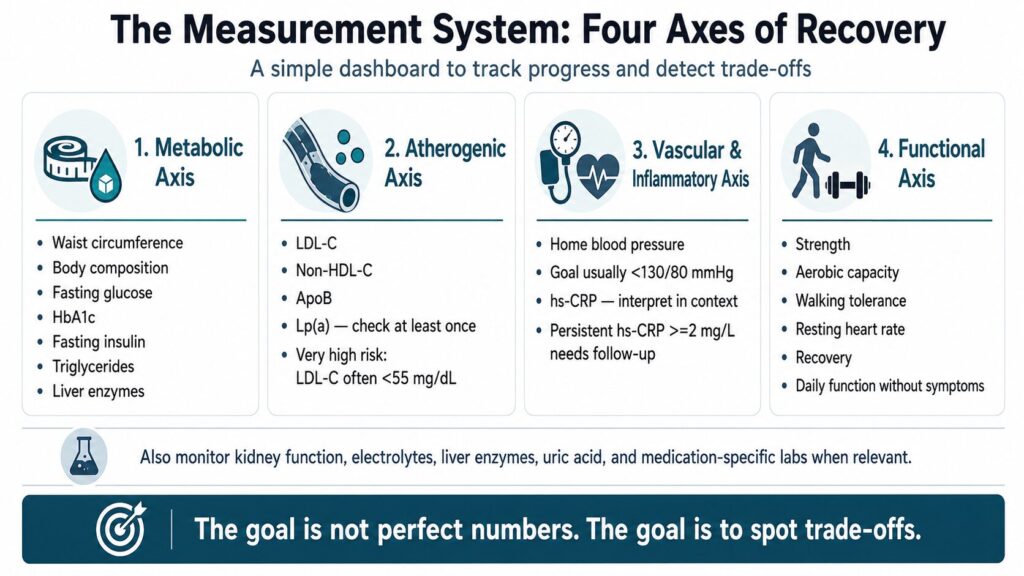
Metabolic axis. Track waist circumference, body composition where useful, fasting glucose, HbA1c and fasting insulin when it will change decisions. HbA1c below the diabetic range is encouraging, but context matters. A person with diabetes usually has an individualized HbA1c target. Fasting insulin is not yet a universal guideline target, but a persistently high level can reveal insulin resistance before glucose looks dramatically abnormal. Triglycerides and liver enzymes add further context.
Atherogenic axis. Track LDL-C, non-HDL cholesterol and ApoB. Measure Lp(a) at least once. In established coronary disease, current secondary-prevention guidance generally aims for very low LDL-C, commonly below 55 mg/dL in very-high-risk patients. ApoB is valuable because it can reveal residual particle risk when LDL-C and particle number disagree.
Vascular and inflammatory axis. Track home blood pressure with a validated cuff. For chronic coronary disease with hypertension, a target below 130/80 mmHg is widely recommended; some contemporary European guidance aims for systolic pressure around 120 to 129 mmHg when well tolerated. hs-CRP can help identify persistent inflammatory risk, but it is nonspecific. Infection, injury and hard training can raise it. A persistent value at or above about 2 mg/L after obvious acute causes are excluded deserves context and follow-up rather than a single dramatic interpretation.
Functional axis. Track strength, aerobic capacity, walking tolerance, resting heart rate, recovery and the ability to perform normal life without symptoms. Fitness is not decoration. Low fitness is a cardiovascular risk marker, and improvement in fitness represents real physiological reserve.
Kidney function, electrolytes, liver enzymes and uric acid may be important when using a ketogenic diet, depending on the person and medication. Medication-specific monitoring remains essential.
The dashboard is not a competition to make every number “optimal.” It is a system for detecting trade-offs.
10. What to Do With Coronary Imaging
Blood tests estimate exposure. Imaging shows the state of the artery.
A coronary calcium scan detects calcified plaque. It is useful for risk assessment in people who have not yet been diagnosed with coronary disease. Once a person already has established coronary disease or a stent, the clinical role is different. Repeating calcium scores at short intervals is generally not a sensible way to judge whether a diet is working. Plaque can become more calcified as it stabilises, and calcium progression can therefore be difficult to interpret.
Coronary CT angiography can show both calcified and non-calcified plaque and can quantify plaque more directly in specialised centres. Modern analysis can separate plaque types and follow changes over time.
For a person pursuing an unconventional risk trade-off—for example, excellent metabolic health with persistently high ApoB—high-quality plaque imaging may be part of a shared decision process. But imaging should complement established risk evidence.
11. Medication: The Most Important Place to Avoid Ideology
The principle is simple: look at the terrain and the physiology. The terrain is the actual disease—how much plaque is present and, when clinically appropriate, whether high-quality imaging suggests it is stable or progressing. The physiology is what the body is doing now—blood pressure, glucose, insulin resistance, triglycerides, ApoB, inflammation, body composition, fitness and other relevant markers. If these improve substantially, the person’s risk profile may be very different from when the medication was first prescribed. That is the point to review treatment.
Different drugs protect against different risks. Antiplatelet drugs reduce clotting risk after stenting. Lipid-lowering drugs reduce ApoB-containing particles. Blood-pressure drugs reduce pressure on the arteries. Diabetes medicines control glucose and, for some drugs, provide additional cardiovascular protection. As the underlying physiology changes, doses and even the need for some treatments can change, but only through clinical review. Current guidance already recognizes that some cardiovascular medicines should not automatically continue indefinitely when their original indication is no longer present.
Many cardiovascular medicines have been studied for several years and some have decades of follow-up. What research cannot tell us is that every person needs every drug at the same dose for the rest of life regardless of how their health changes.
My approach is therefore not “get off medication.” It is reduce the disease burden and repeatedly prove it with objective evidence. Improve metabolic health with nutrition, muscle, movement, sleep and recovery; monitor the blood markers; use appropriate clinical assessment; and review medication with the medical doctor as the risk picture changes.
The goal is the lowest real cardiovascular risk with the least treatment required.
12. A Practical Long-Term Framework for Keto Living
A good ketogenic plan should fit normal life, not make you anxious about food or blood tests.
When nutritional ketosis is introduced properly and monitored well, most changes are predictable and manageable. Glucose often improves quickly, appetite usually becomes easier to control, triglycerides often fall, body fat can reduce and blood pressure may improve. Some people also see changes in LDL-C, ApoB, uric acid, electrolytes or medication needs. These are not mysterious surprises. We know what to look for, why they can happen and what practical steps can usually bring the system back into balance.
The coaching approach is simple: change carefully, measure what matters, understand the response, then adjust.
Most meals should be built around good-quality protein and non-starchy vegetables. Use olive oil, avocado, nuts, seeds and oily fish as the main fats. Butter, cream, cheese, coconut fat and fatty processed meats can be used, but not automatically or in unlimited amounts. Avoid sugar, refined starch and ultra-processed foods as everyday foods.
Carbohydrate intake should be low enough to give the metabolic benefit you need. Once insulin resistance improves, some people can eat slightly more whole-food carbohydrate and still maintain excellent glucose control. There is no health prize for producing the highest ketone reading.
Protein matters, especially as we age. Eat enough to maintain muscle, strength and recovery. Resistance train at least twice a week when medically appropriate, walk every day, build aerobic fitness and avoid sitting for long periods. Higher-intensity exercise can be added when the body is ready and medical clearance is appropriate.
Sleep and recovery are part of the same plan. Aim for regular, restorative sleep. Investigate sleep apnea if there are signs such as heavy snoring, poor sleep or daytime tiredness. Use simple stress-management practices to improve recovery, while remembering that stress reduction supports cardiovascular health but does not replace direct treatment of plaque or other risks.
Monitoring removes much of the uncertainty. After a major dietary change, I normally look at the main metabolic and lipid markers after about six to twelve weeks. If we change the diet again, we test again. Once things are stable, monitoring can become less frequent, based on risk and medical advice.
Blood pressure is best judged from several home readings, not one number. Waist size, body composition and strength are best judged over months, not days. Lp(a) usually only needs to be checked once unless there is a specific reason to repeat it.
If ApoB rises, LDL-C becomes very high, blood pressure changes, kidney markers move, uric acid rises, weight falls too far or exercise performance drops, we look for the reason. Fat quality can be changed. Carbohydrate intake can be adjusted. Protein, fluids, electrolytes and fibre can be improved. Training and recovery can be modified. In some cases, medical treatment can be added or changed.
This is why a well-managed ketogenic transition should feel safe and predictable. Most problems have a reason, most have a way to respond, and objective measurement tells us whether the adjustment worked. My role as a functional nutrition coach is to guide the daily strategy: food, behaviour, body composition, training, recovery, monitoring and interpretation. The medical doctor and cardiologist provide the clinical oversight needed for established cardiovascular disease, medications and imaging.
The aim is a strong, sustainable metabolic state with low cardiovascular risk that works in real life.
Final Thoughts
Medication can reduce important risks. It cannot build muscle, prepare food, improve sleep, reduce visceral fat or create fitness.
Nutritional ketosis can transform glucose control, insulin resistance, triglycerides, appetite, body composition and metabolic health in the right person. It cannot be assumed to neutralise a high ApoB burden or erase existing coronary plaque.
That leaves a more useful goal than defending keto or defending medication.
Measure the human being.
Is glucose control improving? Is insulin resistance falling? Is visceral fat shrinking? Is blood pressure controlled? Is the person stronger and fitter? Is sleep restorative? Is smoking absent? Are triglycerides and remnant risk improving? Is ApoB acceptable for the person’s coronary risk? Is Lp(a) known? Is inflammation persistently low when measured appropriately? Is the clinical course stable? When imaging is clinically justified, is plaque stable?
If most of those answers are moving in the right direction, the system is working. If one important pathway moves in the wrong direction. Modify the plan. This is the deepest lesson after a cardiac event or progressing atherosclerosis. The goal is to reduce the conditions that allow the next event to happen. For someone living after atherosclerosis and or stenting, metabolic health is part of cardiovascular prevention. ApoB management is another part.
The safest long-term strategy is integration: real food, controlled carbohydrate when therapeutically useful, adequate protein, better fat quality, muscle, aerobic fitness, sleep, stress regulation, blood-pressure control, no smoking, appropriate medication and repeated objective measurement.
About Mathew Gomes
Functional Health Coach
Throughout my career, I learned that valuable assets are not just protected from failure. They are strengthened and expected to grow. Yet I treated my health differently.
In my late fifties, a heart attack and two stents changed that. Medical care saved my life, and medication gave me vital protection against another crisis.
But protection limits the downside. It does not build the asset.
So I trained in functional health and nutrition and combined it with executive coaching. Today, I help busy professionals connect their symptoms, test trends, medication, nutrition, sleep, stress, movement and recovery—then turn that complexity into clear priorities and a measurable plan.
Working alongside their doctors, we identify what is driving decline, rebuild function and grow their health asset—so they can extend their best years with energy, strength, clear thinking, independence and confidence.
I am a certified Functional Health and Nutrition Practitioner and an accredited Executive Coach with ICF and EMCC.
Disclaimer
This white paper is provided for educational and informational purposes only. It is not intended to diagnose, treat, cure, prevent, or provide medical advice for any disease or health condition.
The author is a Functional Health, Nutrition and Longevity Coach, not a medical doctor. The content presented reflects a functional, educational perspective on health, lifestyle, nutrition, and risk factors, and is designed to support informed self-care and productive conversations with qualified healthcare professionals. Nothing in this document should be interpreted as a substitute for medical advice, diagnosis, or treatment from a licensed physician or other qualified healthcare provider. Readers should not start, stop, or change any medication, supplement, or medical treatment without consulting their prescribing clinician.
Individual responses to nutrition, lifestyle, supplements, and coaching strategies vary. Any actions taken based on this information are done at the reader’s own discretion and responsibility. If you have a medical condition, are taking prescription medication, or have concerns about your health, you are advised to seek guidance from a licensed healthcare professional before making changes.