

Cellular Aging, Stress, and Biological Time
Executive Summary
Longevity is often framed as living longer. In practice, what most people want is simpler and more human: to feel strong, clear, capable, and young in their body for as long as life lasts. Functional health offers a practical and evidence‑based path to that outcome. It views longevity not as the defeat of aging, but as the sustained preservation of function across the body’s core systems. When function is protected and restored, longevity follows as a natural consequence.
Modern science now confirms what experience has long suggested: aging speed is not fixed by the calendar. It is shaped by how the body adapts to stress, recovers from demand, regulates energy, repairs tissue, and coordinates its internal systems over time. At the cellular level, this shows up in how well cells maintain their integrity and repair capacity. At the whole‑body level, it shows up as strength, resilience, clarity, and the ability to return to balance after pressure.
This white paper brings together cellular aging research, systems‑based functional health, and real‑world coaching experience to explain why developing and maintaining optimal function is the most reliable path to longevity. It explains the science in simple language, connects it to daily life, and shows how functional guidance makes this process practical and achievable. Longevity, in this model, is not about living forever. It is about feeling forever young in your capacity to live.
Aging Reframed: From Time to Function
Most people think of aging as time passing. From a biological perspective, this is incomplete. Two people of the same age can look, feel, and function very differently. The difference is not luck. It is how their bodies have adapted to years of demand.
Biologically, aging is the gradual loss of the body’s ability to restore order after stress. When systems recover fully, repair keeps pace with wear. When recovery is incomplete, small imbalances accumulate. Over time, this accumulation shows up as fatigue, stiffness, sleep disruption, slower recovery, weight gain, declining strength, and reduced tolerance to stress. Disease appears much later, as the final stage of long‑standing loss of function.
Functional health places aging on a continuum. At one end is optimal function: stable energy, deep sleep, strong muscles, calm nerves, efficient metabolism, and coordinated systems. At the other end is disease, where accumulated damage becomes too obvious to ignore. Longevity is about staying as close as possible to the optimal end of that continuum for as long as possible.
The Cellular Foundation: Telomeres and Biological Time
A major breakthrough in understanding aging came from cellular biology. At the center of this work are telomeres, protective structures at the ends of chromosomes that preserve genetic stability when cells divide. Their discovery transformed aging from a vague concept into a measurable biological process.
The scientist most closely associated with this breakthrough is Elizabeth Blackburn, an Australian‑born molecular biologist who conducted her research in the United States. Working with colleagues, she discovered how telomeres function and how an enzyme called telomerase helps maintain them. This work demonstrated that cellular aging is regulated, not merely the result of time. For this discovery, she and her collaborators were awarded the Nobel Prize in Physiology or Medicine in 2009, for uncovering how chromosomes are protected and how cellular aging is governed.
In simple terms, telomeres act like protective caps. Each time a cell divides, they shorten slightly. This is normal. What matters is how fast they shorten. Research shows that telomere shortening accelerates when cells live in an environment of chronic stress, inflammation, unstable energy supply, poor sleep, and ongoing threat signaling. It slows when the body regularly returns to a state that supports repair.
Telomeres are not the cause of aging; they are a read‑out of how cells experience life. They reflect whether the body has spent more time in survival mode or in recovery mode. This insight is crucial. It means that biological aging is responsive to daily inputs. When those inputs change, the trajectory changes.
Stress, Recovery, and the Cost of Modern Life
Stress is not inherently harmful. It is a survival program designed to mobilise energy and focus in the short term. The problem is not stress itself, but the absence of recovery.
Modern life delivers constant low‑grade stress signals: mental pressure, time scarcity, artificial light, irregular meals, disrupted sleep timing, emotional load, and continuous stimulation. The nervous system rarely receives a clear signal that demand has ended. As a result, stress chemistry stays partially elevated. The body remains alert, even when nothing immediate is wrong.
At the cellular level, this environment shifts priorities. Repair is postponed. Inflammation rises. Energy production becomes less efficient. Telomere maintenance becomes harder, not because of age, but because the cellular environment feels unsafe. Over years, this leads to faster biological aging.
The practical insight is simple but powerful: recovery capacity is the real anti‑aging mechanism. Anything that reliably restores the body to baseline after stress supports longevity. Anything that keeps the system permanently activated accelerates decline.
Function as the Core Definition of Health
Functional health begins by redefining health itself. Health is not the absence of disease. It is functional capacity: the ability of the body’s systems to meet demand and return to balance.
The body operates through interconnected systems that constantly communicate. Energy regulation, nervous system signaling, digestion, immunity, inflammation control, circulation, structural integrity, and hormonal rhythm do not function independently. When one system drifts, others adapt in response.
Loss of function rarely appears as a single problem. It shows up as patterns: lighter sleep alongside rising blood pressure, fatigue alongside digestive sensitivity, stiffness alongside weight gain, anxiety alongside unstable energy. These patterns reflect systems losing coordination, not isolated failures.
Disease is simply the end of this process. Long before a diagnosis appears, function has already declined. Longevity, therefore, depends on recognising and correcting loss of function early, while the system is still highly adaptable.
The Three Drivers of Functional Longevity
Functional health works through three primary drivers: diet and nutrition, lifestyle, and environment. These are not wellness concepts. They are the main inputs that shape gene expression, stress chemistry, inflammation, metabolism, and repair.
Diet is not just fuel. It is biological information. Every meal sends signals that influence blood sugar stability, hormone release, immune activity, gut integrity, and cellular energy production. Diets with the same calories can produce completely different outcomes depending on food quality, timing, protein adequacy, and metabolic context. Stable energy is one of the strongest signals of safety a cell can receive.
Lifestyle governs rhythm. Sleep timing, light exposure, movement, breathing patterns, and recovery habits tell the nervous system whether it is safe to repair. Deep sleep is a cellular repair state. Regular movement preserves muscle, improves insulin sensitivity, and supports mitochondrial function. Breathing patterns and stress regulation determine whether the body spends most of its time in threat or in recovery.
Environment is the background signal. Work demands, social dynamics, toxin exposure, noise, light, and even emotional climate all influence biology. A supportive environment reduces unnecessary strain. A hostile one keeps systems defensive. Functional longevity does not require a perfect environment, but it does require reducing chronic, avoidable load.
When these three drivers align with human biology, function stabilises and repair resumes naturally.
Longevity as a Continuum of Function
Health and disease are not opposites; they are points on a continuum. At one end is optimal function, where systems are coordinated and resilient. At the other end is disease, where accumulated dysfunction has caused structural damage.
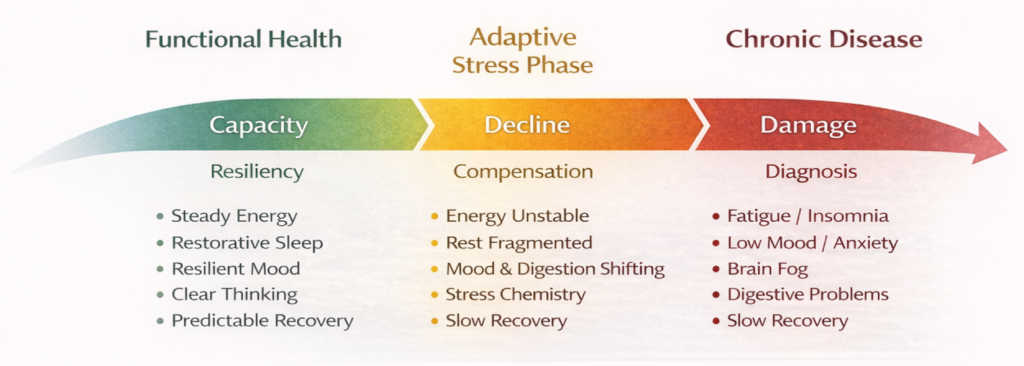
Most people live in the middle for years. They are not sick, but they are not well. Energy fluctuates. Sleep is light. Recovery takes longer. Stress tolerance shrinks. These are not inevitable signs of aging. They are signs of declining function.
Functional health focuses precisely on this middle ground. This is where the greatest leverage exists. Small changes in inputs produce large improvements in output because systems are still flexible. This is why functional guidance emphasises early patterns rather than late diagnoses.
Longevity emerges when people stay on the functional side of the continuum for as long as possible.
What Functional Health Requires: Systems Thinking and Pattern Recognition
Functional health requires a different way of thinking. Instead of asking, “What disease is this?” it asks, “Which systems are under strain, and why?”
Systems thinking recognises that the body behaves as an integrated whole. Pattern recognition looks for repeated relationships between symptoms, habits, stressors, and biological markers. For example, fatigue with afternoon cravings and light sleep points toward unstable energy regulation. Digestive issues with anxiety and poor sleep point toward nervous system overload. Joint pain with central fat gain points toward metabolic inflammation.
These patterns are not failures. They are intelligent adaptations to long‑term pressure. Understanding them removes blame and replaces confusion with clarity. Once the pattern is clear, intervention becomes simpler and more precise.
Why Guidance Matters
Many people know what they should do but still struggle to improve. This is not a motivation problem. It is a sequencing and load problem. Functional guidance works because it restores order in the right sequence. Energy stability comes before aggressive exercise. Nervous system regulation comes before perfect nutrition. Sleep and recovery come before optimisation. When the body feels safer, effort drops and consistency rises.
Guidance also reduces cognitive load. Instead of chasing every new idea, people follow a clear structure. They understand why each step matters. Progress becomes visible and reinforcing.
Most importantly, functional guidance respects real life. It works within work demands, family responsibilities, travel, and stress. It is not about doing everything. It is about doing the right things in the right order.
Motivation, Money, and Feeling Young
People pursue longevity for practical reasons. They want to protect their ability to work, earn, and live fully. Chronic illness is expensive in every sense: financially, emotionally, and socially. Preserving function reduces long‑term medical costs and dependency.
But beyond money, the strongest driver is how people feel in their bodies. When energy is steady, sleep is deep, strength is maintained, and the mind is clear, people feel younger. Confidence returns. Life expands instead of shrinking.
This is why longevity is not about living forever. It is about feeling forever young in capacity, even as years pass.
The Simplicity on the Other Side of Understanding
Functional health can sound complex because biology is complex. In practice, once the principles are understood, the process becomes simpler, not harder.
Stabilise energy. Restore sleep. Calm the nervous system. Reduce inflammatory load. Build and maintain muscle. Support digestion. Align rhythm. These are not extreme interventions. They are basic human requirements that modern life often disrupts. When these foundations are restored, the body does what it has always been designed to do: repair, adapt, and sustain function over time.
Final Thoughts: Longevity as the Gift of Function
Longevity is not granted by medicine alone, nor by willpower. It emerges when function is protected and restored across the body’s systems. Cellular research shows that biological aging is responsive. Systems science shows that health is coordinated. Real‑world experience shows that when people restore rhythm, stability, and recovery, they age more slowly and live more fully.
Functional health offers a clear message: pursue function, and longevity follows. Not as an abstract future goal, but as a lived, daily experience of strength, clarity, and resilience.
References
Blackburn, E.H. & Epel, E.S. (2017). The Telomere Effect. New York: Grand Central Publishing.
Bland, J.S. (2019). The Disease Delusion. New York: Hachette.
McGuff, D. & Little, J. (2013). Body by Science. New York: McGraw‑Hill.
Phinney, S.D. & Volek, J.S. (2011). The Art and Science of Low Carbohydrate Living. Beyond Obesity LLC.
Li, W. (2019). Eat to Beat Disease. New York: Grand Central Publishing.
Porges, S.W. (2011). The Polyvagal Theory. New York: Norton.
Levine, P.A. (2010). In an Unspoken Voice. Berkeley: North Atlantic Books.
About Mathew Gomes
Functional Health, Nutrition & Longevity Coach
Mathew Gomes is a Functional Health, Nutrition & Longevity Coach helping busy professionals reverse early health decline before it becomes disease. Trained in Functional Nutrition Coaching (AAFH) and certified in executive coaching (ICF, EMCC), with an engineering background and MBA, he brings systems thinking and strategic clarity to health restoration.
Shaped by senior leadership experience and a personal health crisis, Mathew uses functional assessment and targeted testing to identify root causes and coordinate personalised nutrition, metabolic repair, strength training, nervous-system regulation, sleep and recovery. He works alongside doctors for diagnosis and medication while building resilient, sustainable health—so clients regain energy, focus and confidence without guesswork.
Disclaimer
This white paper is provided for educational and informational purposes only. It is not intended to diagnose, treat, cure, prevent, or provide medical advice for any disease or health condition.
The author is a Functional Health, Nutrition and Longevity Coach, not a medical doctor. The content presented reflects a functional, educational perspective on health, lifestyle, nutrition, and risk factors, and is designed to support informed self-care and productive conversations with qualified healthcare professionals. Nothing in this document should be interpreted as a substitute for medical advice, diagnosis, or treatment from a licensed physician or other qualified healthcare provider. Readers should not start, stop, or change any medication, supplement, or medical treatment without consulting their prescribing clinician.
Individual responses to nutrition, lifestyle, supplements, and coaching strategies vary. Any actions taken based on this information are done at the reader’s own discretion and responsibility. If you have a medical condition, are taking prescription medication, or have concerns about your health, you are advised to seek guidance from a licensed healthcare professional before making changes.