MATHEW’S CALM GUT GUIDE
A functional nutrition food framework for gut calm, glucose stability, immune balance and resilient energy
This guide is designed to help a person eat in a way that lowers avoidable gut fermentation, reduces rapid glucose and insulin pressure, supplies anti-inflammatory nutrients and uses resistant starch intelligently rather than randomly.
A low-FODMAP approach is normally a structured short-term elimination and reintroduction tool, not a permanent low-variety diet. Use medical input for diagnosed disease, unexplained weight loss, bleeding, fever, anaemia, persistent vomiting, severe pain, new symptoms after age 50 or any complex medical history.
Contents
1. Executive summary
2. The three filters: FODMAP load, glycaemic load and inflammatory load
3. Why resistant starch matters and how to use it safely
4. How to use the green, amber and red system
5. The food guide by category
6. Meal construction rules
7. Resistant-starch preparation protocols
8. Seven-day implementation rhythm
9. Symptom-guided coaching adjustments
10. Shopping, cooking and eating-out rules
11. Reintroduction and personalisation
12. Reference notes
1. Executive Summary
This guide takes a low-FODMAP and anti-inflammatory food list and upgrades it into a functional nutrition framework. The aim is to create a calmer gut, a steadier blood-glucose curve, a lower inflammatory food environment and a more personalised long-term diet.
The traffic-light system uses three practical signals.
Green means minimal fermentation load and anti-inflammatory potential for most people.
Amber means conditional load: the food may be useful, but portion, preparation, timing and tolerance matter.
Red means high fermentation load, high glucose load, inflammatory trigger potential, additive burden or poor fit during a gut-sensitive reset phase.
The low-FODMAP filter helps reduce bloating, abdominal pressure, cramping, gas, diarrhoea and constipation shifts in people whose symptoms are driven by poorly absorbed fermentable carbohydrates.
The low-glycaemic-load filter helps reduce the size and speed of post-meal glucose rises.
The anti-inflammatory filter helps reduce the food patterns most likely to amplify oxidative stress, immune irritation, poor sleep, visceral sensitivity and metabolic dysfunction.
The resistant-starch layer is the bridge between gut and metabolism. Resistant starch is starch that resists digestion in the small intestine. It reaches the colon, where gut microbes can ferment it into short-chain fatty acids such as butyrate. Butyrate is one of the key fuels for colon cells and is involved in barrier integrity, immune signalling and metabolic communication. However, resistant starch is still fermentable. In a reactive gut it must be introduced slowly, because a helpful fibre for one person can be gas pressure for another.
The practical rule: Build meals from protein first, low-FODMAP vegetables second, quality fat third, then add a measured amount of smart starch only if it fits activity level, glucose response and gut tolerance. This produces food that is calmer, more satiating and easier to repeat.
2. The Three Filters
2.1 Low-FODMAP means lower fermentation load
FODMAPs are fermentable carbohydrates. In sensitive people they can pull water into the intestine and feed rapid bacterial fermentation. The result can be bloating, pain, wind, loose stools, constipation shifts or a feeling that food is sitting and fermenting. FODMAPs are not toxins. Many are useful prebiotic fibres in people who tolerate them. The problem is timing, dose, gut state and individual tolerance.
A functional approach uses a reset phase to reduce symptoms, then a challenge phase to discover which FODMAP groups and portions are genuinely problematic, then a personalisation phase to bring back as much variety as the body can handle.
- Reset phase: reduce high-FODMAP foods and obvious inflammatory triggers for 2-6 weeks, or until symptoms are clearly calmer.
- Challenge phase: test one food or FODMAP family at a time while the rest of the diet stays stable.
- Personalisation phase: keep the foods that work, limit only the foods that reliably trigger symptoms, and rebuild diversity carefully.
2.2 Low glycaemic load means lower real-world glucose pressure
Glycaemic index describes how fast a carbohydrate-containing food raises blood glucose compared with glucose. Glycaemic load is more practical because it combines the speed of the carbohydrate with the amount eaten. A food can have a high glycaemic index but a low glycaemic load if the portion contains little carbohydrate. A low-FODMAP starch can still be high glycaemic if the serving is large, hot, soft, refined and eaten without protein or fibre.
In this guide, the glucose filter is applied through portion, sequence and food form.
Protein comes first. Vegetables and fat slow the meal. Starch is measured. Cooked-and-cooled starch can be used when appropriate. Glucose response is then checked through energy, hunger, sleep, waist response, triglycerides, fasting insulin, HbA1c or CGM when available.
- Low-glycaemic pattern: protein + low-FODMAP vegetables + olive oil or other quality fat + optional small resistant-starch portion.
- High-glycaemic pattern: rice/noodles/potatoes/bread as the meal base + sweet sauce + low protein + refined oil + dessert or juice.
- The same food can behave differently depending on sleep, stress, exercise, meal order, cooking method and portion.
2.3 Anti-inflammatory means food that lowers immune irritation
Inflammation is a network of immune signals, oxidative stress, gut barrier signals, blood sugar swings, adipose tissue signals, sleep disruption and stress hormones. Food can calm or amplify that network. Anti-inflammatory food is defined by the repeated daily pattern.
The anti-inflammatory pattern in this guide emphasises extra virgin olive oil, oily fish, clean proteins, colourful vegetables, herbs, spices, berries, citrus, nuts, seeds and simple condiments. It reduces refined oils, hydrogenated fats, ultra-processed meats, packaged sauces, sweet drinks, fruit concentrates, sugar alcohols, deep-fried foods and additive-heavy products.
Coach note: The body does not read food labels as ideology. It reads glucose load, fermentation load, fat quality, micronutrients, additives, meal timing, stress state and total dose.
3. Why Resistant Starch Matters
Resistant starch is a functional food form. It is starch that escapes digestion in the small intestine and reaches the colon. There, gut bacteria can ferment it into short-chain fatty acids. The key short-chain fatty acid for gut barrier health is butyrate. Butyrate helps fuel colon cells, supports barrier integrity and participates in immune and metabolic signalling.
The most useful everyday form is retrograded starch. This forms when starchy foods are cooked, cooled and sometimes reheated. The cooling step allows some starch chains to reorganise into a structure that human enzymes digest less easily. The result is often a lower glycaemic response than freshly cooked starch. The effect is useful, but it is not magic. Portion size still matters.
The resistant-starch food forms used in this guide
- Cooked-and-cooled rice: basmati rice, white rice, jasmine rice, red rice or black rice cooked, cooled quickly, refrigerated and then eaten cold or reheated once.
- Cooked-and-cooled potatoes: boiled or steamed potatoes cooled and used as potato salad or reheated with herbs and olive oil.
- Cooked-and-cooled oats: oats cooked or soaked, cooled and paired with protein, chia, nuts and cinnamon rather than sugar.
- Cooked-and-cooled millet, sorghum, quinoa or polenta: used in small portions when tolerated and paired with protein and vegetables.
- Green banana flour: a concentrated resistant-starch ingredient; start extremely low because it can ferment quickly.
- Cooked-and-cooled dals or beans: potentially useful after reintroduction, but not a first-line reset food for highly sensitive guts.
Food-safety rule for resistant starch
Cooked rice, potatoes and other starches must be cooled safely. Divide into shallow containers, refrigerate promptly, keep refrigerated, and reheat thoroughly if reheating. Do not leave cooked rice or starches sitting at room temperature for long periods. Resistant starch is only functional if food safety is respected.
Start low: For IBS, SIBO-pattern bloating or active gut sensitivity, resistant starch should begin as a small food dose, not a heroic fibre dose. Start with a few tablespoons of cooled rice or potato, or a tiny amount of green banana flour, then build only if symptoms remain calm.
4. How to Use the Green, Amber and Red System
The guide uses the same traffic-light language throughout: green, amber and red. This keeps the system simple enough to use in real life.
- Green: minimal fermentation + anti-inflammatory. These foods are the default reset foods. They should make up most meals during the calming phase.
- Amber: conditional load. These foods may be useful, but the result depends on portion, preparation, timing, symptoms, glucose response and individual tolerance.
- Red: high fermentation or inflammatory trigger. These foods are best removed during the reset and then tested only if there is a clear reason.
This system is intentionally conservative. A food listed red may be tolerated by a specific person in a specific portion. A food listed green may still cause symptoms if eaten in excess, eaten raw, eaten during a flare or combined with stress, poor sleep and a large meal. The body always has the final vote.
The functional sequence of eating
- Start with protein to stabilise appetite, muscle signalling and glucose response.
- Add low-FODMAP vegetables for volume, micronutrients and polyphenols.
- Add quality fat for satiety, fat-soluble nutrient absorption and flavour.
- Add smart starch only when needed for activity, body composition, sleep, thyroid/adrenal context or personal preference.
- Use herbs, spices and simple condiments to make the meal repeatable.
5. The Food Guide by Category
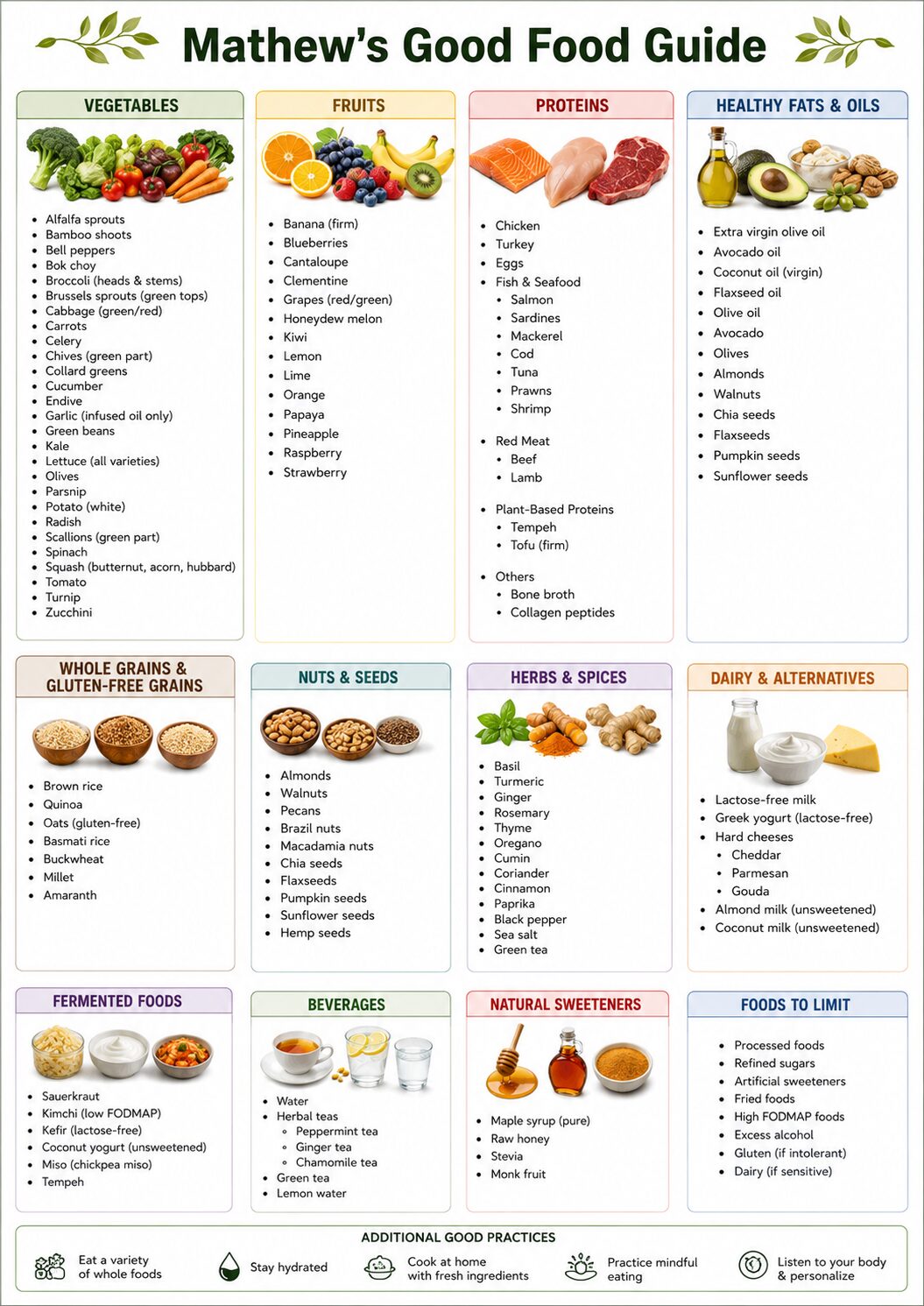
The following sections retain the full food information from the guide and convert each category into practical functional nutrition use. The aim is to make each list usable without a table, so it can be cut and pasted into website format easily.
1. Vegetables
Green – minimal fermentation + anti-inflammatory
Spinach, baby spinach, kale, Swiss chard, rocket (arugula), lettuce (all types), endive, radicchio, amaranth leaves, fenugreek leaves, mustard greens, dill leaves, mint, coriander leaves, Thai basil, curry leaves, zucchini, eggplant (aubergine), cucumber, carrots, pumpkin, bottle gourd, ridge gourd, snake gourd, ash gourd (winter melon), tomatoes, bell peppers (red, yellow, green), green beans, French beans, okra, bamboo shoots, fennel bulb, olives, turnip greens, water spinach (kangkung), chives
Amber – conditional load
Beetroot, sweet potato, yam, taro (arbi), parsnip, radish, pak choi, cabbage, Brussels sprouts, turnip, lotus root, chayote, artichoke, asparagus, leeks (green tops), spring onion greens, raw papaya, green peas, broad beans, drumstick pods (moringa), drumstick leaves, banana stem, banana flower
Red – high fermentation or inflammatory trigger
Onion (white, red, brown), garlic (all forms), shallots, leek bulb, spring onion whites, cauliflower, mushrooms (button, shiitake, porcini, oyster), large broccoli portions, Jerusalem artichoke
Functional interpretation
Functional reading: This section is the core of the guide because low-FODMAP eating should not become a low-plant diet. Green vegetables provide potassium, magnesium, folate, vitamin C, carotenoids, nitrate-rich greens, bitter compounds, fibre and polyphenols while keeping fermentable load relatively low for most sensitive guts.
Low-glycaemic layer: Leafy greens, gourds, cucumber, zucchini, eggplant, tomatoes, peppers, green beans, okra, herbs and olives have a very low glycaemic load. Pumpkin and carrots remain useful but portions matter for people using glucose monitoring.
Anti-inflammatory layer: Use colour, herbs and culinary fat together. Carotenoid-rich vegetables need fat for better absorption. Olive oil, ghee or coconut milk used in modest amounts can improve flavour, satiety and nutrient uptake.
Resistant-starch layer: Most green vegetables are not resistant-starch foods. The starchier amber vegetables, especially cooked-and-cooled sweet potato, yam, taro and lotus root, can be tested as activity-linked smart starches after the gut has settled.
How to use in practice
- Use vegetables cooked, peeled, seeded or blended when the gut is reactive. Raw salads can be healthy but may mechanically irritate a sensitive bowel if used too early.
- Use onion and garlic flavour through infused oil rather than pieces of onion or garlic. The flavour compounds move into oil; the water-soluble FODMAP sugars largely do not.
- Use herbs heavily. Mint, coriander leaves, Thai basil, dill leaves, curry leaves, rosemary, thyme and parsley allow food to feel abundant without onion-garlic dependence.
- Large broccoli portions are listed red because dose matters. A small serving may be tolerated by some people, but this guide places it in red for a conservative reset phase.
- Amber vegetables are not “bad”. They are conditional because portion, cooking method, gut state, histamine state, meal size and glucose response change the outcome.
2. Fruits
Green – minimal fermentation + anti-inflammatory
Strawberries, blueberries, raspberries, oranges, mandarins, tangerines, lemon, lime, kiwi, pineapple, papaya, grapes, cantaloupe, honeydew melon, dragon fruit, passionfruit
Amber – conditional load
Banana (ripe), mango, pomegranate, peach, plum, apricot, cherries, coconut flesh
Red – high fermentation or inflammatory trigger
Apple, pear, watermelon, lychee, longan, rambutan, durian, figs, dates, raisins, prunes, fruit juices, fruit concentrates
Functional interpretation
Functional reading: Fruit is best treated as a polyphenol and micronutrient tool, not as a free sugar snack. The goal is to gain vitamin C, potassium, flavonoids, anthocyanins and digestive enzymes without overwhelming fructose load or FODMAP load.
Low-glycaemic layer: Berries, citrus, kiwi, passionfruit and small servings of papaya or dragon fruit are usually the most useful choices. Grapes, pineapple and melon can still be green for fermentation but may need portion control for glucose.
Anti-inflammatory layer: Berries and citrus are especially useful because they deliver polyphenols with a modest sugar load. Lemon and lime also support flavour, gastric stimulation and sauce replacement.
Resistant-starch layer: Ripe banana is amber because sugars rise as the banana ripens. Green banana or green banana flour contains more resistant starch but should be introduced carefully because it can still ferment and cause gas in sensitive people.
How to use in practice
- Use fruit after a protein-based meal rather than alone when glucose control matters.
- Use berries with lactose-free yogurt or coconut yogurt if tolerated, or with chia and cinnamon for a lower-glycaemic dessert.
- Avoid juices during the reset. Juice removes chewing, concentrates sugars and makes dose control harder.
- Dried fruit is red because dehydration concentrates fructose and makes overconsumption easy.
- Use fruit as a flavour and micronutrient layer, not as the meal foundation.
3. Grains, Starches & Flours
Green – minimal fermentation + anti-inflammatory
White rice, basmati rice, jasmine rice, red rice, black rice, rice flakes (poha), rice noodles, vermicelli (rice), quinoa, oats, millet (bajra), sorghum (jowar), finger millet (ragi), polenta, cornmeal, tapioca, sabudana, arrowroot, potatoes
Amber – conditional load
Brown rice, buckwheat (kuttu), corn, makki flour, gluten-free bread, fermented dosa batter, idli batter
Red – high fermentation or inflammatory trigger
Wheat (atta, maida), semolina (suji), naan, roti, paratha, pasta (wheat), barley, rye, couscous
Functional interpretation
Functional reading: This is the section where the three filters must be separated. A food can be low-FODMAP but still high glycaemic if the portion is large. Rice and potatoes may be easier on fermentation than wheat or onion-rich foods, but they still need portion intelligence.
Low-glycaemic layer: White rice, rice noodles, vermicelli, tapioca, sabudana, arrowroot and potatoes can raise glucose quickly when eaten hot, soft and in large portions. Basmati, red rice, black rice, oats, quinoa, millet, sorghum and finger millet usually give a better metabolic result when portion-controlled and paired with protein, vegetables and fat.
Anti-inflammatory layer: The inflammatory problem is usually not starch itself. It is the combination of refined starch, large portions, low protein, low fibre, poor sleep, stress hormones, insulin resistance, oxidised oils and ultra-processed sauces.
Resistant-starch layer: Cooked-and-cooled rice, potatoes, oats, millet, quinoa and similar starches form retrograded starch. This can lower the immediate glucose effect and feed butyrate-producing gut microbes, but it can still create gas if introduced too aggressively.
How to use in practice
- Use starch as a measured dose after protein and vegetables, not as the centre of the plate.
- Best method for rice: cook, cool quickly, refrigerate, then reheat once until steaming hot. Keep the portion modest and pair with protein, herbs and vegetables.
- Best method for potatoes: boil or steam, cool in the refrigerator, then use cold in a salad or reheat with olive oil, herbs and protein. Avoid deep-fried potato forms.
- Best method for oats: use small portions, preferably soaked or cooked and cooled, then combine with chia, cinnamon, nuts and protein rather than sugar or dried fruit.
- Wheat products are red because fructans are a common FODMAP trigger and refined wheat forms also tend to carry a higher glycaemic load.
4. Legumes, Dal & Beans
Green – minimal fermentation + anti-inflammatory
Firm tofu, tempeh
Amber – conditional load
Moong dal, masoor dal, toor dal, urad dal, chana dal, peanuts, edamame
Red – high fermentation or inflammatory trigger
Chickpeas, rajma (kidney beans), black beans, soybeans (whole), baked beans, large mixed lentils
Functional interpretation
Functional reading: Legumes can be metabolically helpful because they contain fibre, protein, minerals and resistant starch, but they are also common fermentation triggers. This is why the guide separates firm tofu and tempeh from whole beans and large lentil portions.
Low-glycaemic layer: Lentils and beans often have a lower glycaemic impact than refined starch because their fibre and protein slow glucose release. However, low glycaemic does not automatically mean low-FODMAP.
Anti-inflammatory layer: For people who tolerate them, legumes can support the microbiome and improve meal satiety. For people with IBS, SIBO-pattern bloating or diarrhoea, they may create enough gas to worsen symptoms during the reset phase.
Resistant-starch layer: Cooked-and-cooled dals and beans increase resistant-starch contribution, but the FODMAP burden remains relevant. Reintroduce in small, measured amounts only after symptoms settle.
How to use in practice
- Start with firm tofu or tempeh if plant protein is needed because processing reduces some fermentable load compared with whole soybeans.
- When testing dal, use small amounts of well-cooked, soaked and rinsed dal. Split dals are usually easier than whole beans.
- Use spices such as cumin, coriander, fennel, ginger and asafoetida in tiny amounts if tolerated to support digestion and flavour.
- Avoid making dal the main protein during an active gut flare. Use it as a test food, not a base food.
- If symptoms include severe bloating within hours, pressure, burping, diarrhoea or constipation shifts, reduce the dose and retest later.
5. Animal Proteins
Green – minimal fermentation + anti-inflammatory
Eggs, chicken, turkey, duck, lamb, mutton, beef, pork, fish (salmon, sardine, mackerel, tuna, cod), prawns, crab, lobster
Amber – conditional load
Processed meats with clean ingredients
Red – high fermentation or inflammatory trigger
Sausages, salami, bacon, deli meats with additives, processed meat products
Functional interpretation
Functional reading: Animal proteins are naturally low-FODMAP and have almost no glycaemic load. They provide amino acids for gut repair, immune regulation, glutathione production, muscle maintenance, detoxification enzymes and satiety.
Low-glycaemic layer: Protein reduces the glucose impact of the whole meal when eaten before or with carbohydrate. It also helps prevent the “carb-only” glucose curve that often follows rice, potatoes or fruit eaten alone.
Anti-inflammatory layer: The most anti-inflammatory animal proteins are usually oily fish, seafood, clean poultry and minimally processed meats. The most inflammatory pattern is processed meat plus refined starch plus refined oils plus sugary sauces.
Resistant-starch layer: Animal proteins do not provide resistant starch. Their role is to anchor the meal so resistant-starch foods can be used in smaller, safer portions.
How to use in practice
- Use eggs, fish, poultry, meat or seafood as the first decision in the meal.
- Choose oily fish such as salmon, sardine and mackerel regularly for omega-3 fats.
- Use slow-cooked meats if digestion is weak because softer proteins are often easier to tolerate.
- Use marinades based on lemon, lime, herbs, ginger, mustard, olive oil, coconut aminos and spice rubs without onion/garlic powder.
- Use processed meats only if ingredients are clean and the person tolerates histamine, salt and additives.
6. Dairy & Alternatives
Green – minimal fermentation + anti-inflammatory
Ghee, butter, lactose-free milk, hard cheeses (cheddar, parmesan), almond milk, coconut milk
Amber – conditional load
Yogurt, curd, kefir, paneer, soft cheeses
Red – high fermentation or inflammatory trigger
Regular milk, cream, ice cream, sweetened dairy products
Functional interpretation
Functional reading: Dairy tolerance depends on lactose load, casein sensitivity, histamine response, portion size and product quality. Ghee, butter and hard cheeses are usually easier because lactose is very low. Lactose-free milk removes the main FODMAP issue but not every dairy sensitivity issue.
Low-glycaemic layer: Unsweetened dairy and unsweetened alternatives generally have low glycaemic load. Sweetened dairy products are red because sugar can drive glucose load and gut symptoms.
Anti-inflammatory layer: Dairy can be supportive or problematic. It can provide calcium, protein and fat-soluble nutrients, but it may aggravate congestion, acne, reflux, histamine symptoms or immune reactivity in susceptible people.
Resistant-starch layer: Dairy does not provide resistant starch but can pair well with resistant-starch foods, for example cooled oats with lactose-free yogurt or a small cooled potato salad with yogurt dressing if tolerated.
How to use in practice
- Use lactose-free dairy first when symptoms suggest lactose intolerance.
- Use hard cheese in small amounts for flavour rather than large portions.
- Use kefir or yogurt only when fermentation is tolerated. During histamine-sensitive phases, even healthy fermented foods may be too stimulating.
- Use coconut milk and almond milk unsweetened. Avoid gums and additives if they trigger symptoms.
- Remove sweetened dairy during the reset because it combines lactose, sugar and additives.
7. Fats & Oils
Green – minimal fermentation + anti-inflammatory
Extra virgin olive oil, coconut oil, ghee, butter, avocado oil, olives
Amber – conditional load
Sesame oil, peanut oil
Red – high fermentation or inflammatory trigger
Refined vegetable oils, sunflower oil (excess), soybean oil, margarine, hydrogenated oils
Functional interpretation
Functional reading: Fat does not contain FODMAPs and has no glycaemic load, but fat quality strongly affects inflammation, cell membrane health, bile flow, satiety and the absorption of fat-soluble nutrients.
Low-glycaemic layer: Adding a modest amount of fat to a meal can slow gastric emptying and reduce the speed of glucose appearance, but excess fat can worsen reflux, gallbladder symptoms or diarrhoea in some people.
Anti-inflammatory layer: Extra virgin olive oil is the anchor fat because it provides monounsaturated fat and polyphenols. Olives also add bitter compounds and flavour. Ghee and butter are low-FODMAP but should be used according to cardiometabolic context.
Resistant-starch layer: Fats pair well with cooled starches. Olive oil on cooled potatoes or rice, for example, improves flavour and satiety while keeping the meal less glycaemically aggressive than a dry starch portion.
How to use in practice
- Use extra virgin olive oil for salads, dressings and low-to-medium heat cooking.
- Use ghee or coconut oil where flavour and cooking style fit, but do not let saturated fat displace omega-3 fish, olive oil, nuts and seeds.
- Use sesame oil and peanut oil as flavour accents rather than the main daily oil.
- Avoid repeatedly heated oils, deep-fried foods and packaged foods built on refined oils.
- Read labels. The oil problem is often hidden inside snacks, sauces, breads, spice pastes and restaurant cooking.
8. Nuts & Seeds
Green – minimal fermentation + anti-inflammatory
Almonds, walnuts, macadamia, pecans, chia seeds, flax seeds, pumpkin seeds, sesame seeds, sunflower seeds
Amber – conditional load
Cashews, pistachios, peanuts, fox nuts (makhana)
Red – high fermentation or inflammatory trigger
Sweetened nut products, nut spreads with additives
Functional interpretation
Functional reading: Nuts and seeds are dense foods. They can support minerals, fibre, omega-3 precursors, vitamin E, polyphenols and satiety, but they can also trigger symptoms if portions become large.
Low-glycaemic layer: Most nuts and seeds are low glycaemic because they are higher in fat, fibre and protein than digestible carbohydrate. Sweetened nut products lose this advantage.
Anti-inflammatory layer: Walnuts, chia and flax are useful for plant omega-3 precursors. Pumpkin seeds add magnesium and zinc. Sesame seeds and tahini support minerals and flavour. Variety matters.
Resistant-starch layer: Nuts and seeds are not major resistant-starch foods, but they can lower the overall glucose effect of oats, fruit or cooled starch when used as part of a balanced meal.
How to use in practice
- Use small handfuls, not open bowls.
- Use chia or ground flax in tiny amounts first if constipation is present, and always increase water with fibre.
- Use cashews and pistachios cautiously because they are often higher-FODMAP in practical portions.
- Use nut butters only when ingredients are simple: nut or seed plus salt. Avoid sugar, emulsifiers and seed-oil blends.
- Rotate nuts and seeds rather than eating the same one daily in large amounts.
9. Herbs, Spices & Aromatics
Green – minimal fermentation + anti-inflammatory
Turmeric, ginger, cumin, coriander seeds, fennel, mustard seeds, basil, oregano, thyme, rosemary, parsley, dill, mint, curry leaves, lemongrass, galangal, cinnamon, cloves, cardamom, star anise, black pepper
Amber – conditional load
Chilli, paprika, tamarind
Red – high fermentation or inflammatory trigger
Garlic powder, onion powder, spice mixes containing onion/garlic
Functional interpretation
Functional reading: This is the section that makes the guide practical. Removing onion and garlic can make food feel flat unless flavour is deliberately rebuilt through herbs, spices, acid, salt, fat and texture.
Low-glycaemic layer: Herbs and spices have minimal glycaemic load in normal culinary doses. Cinnamon may improve the flavour of lower-sugar meals and reduce the need for sweeteners.
Anti-inflammatory layer: Turmeric, ginger, rosemary, oregano, thyme, cloves, cinnamon and black pepper provide strong polyphenol and antioxidant signalling. They are not medicines in culinary doses, but they help build an anti-inflammatory food environment.
Resistant-starch layer: Spices do not provide resistant starch. Their role is to make low-FODMAP and low-glycaemic food enjoyable enough to repeat.
How to use in practice
- Build flavour with ginger, cumin, coriander seeds, fennel, mustard seeds, curry leaves, lime and fresh herbs.
- Use chilli and paprika as amber because they can aggravate reflux, diarrhoea, histamine symptoms or visceral sensitivity.
- Use tamarind carefully because acidity and dose matter.
- Avoid commercial spice mixes unless onion and garlic powder are clearly absent.
- Use black pepper with turmeric when tolerated because it improves the functional impact of turmeric compounds.
10. Condiments & Sauces
Green – minimal fermentation + anti-inflammatory
Olive oil dressings, vinegar, mustard, tahini, coconut aminos, fish sauce, lime juice
Amber – conditional load
Soy sauce, tamari, tomato paste, pesto (without garlic)
Red – high fermentation or inflammatory trigger
Ketchup, barbecue sauce, sweet chilli sauce, curry pastes, packaged chutneys, oyster sauce
Functional interpretation
Functional reading: Condiments are where many gut plans fail. The main meal may be clean, but sauces often bring onion, garlic, wheat, sugar, high-fructose sweeteners, additives, gums and refined oils.
Low-glycaemic layer: Mustard, vinegar, lime juice, tahini, fish sauce and coconut aminos are usually lower glycaemic than sweet sauces. Ketchup, barbecue sauce and sweet chilli sauce can add a hidden sugar load.
Anti-inflammatory layer: Olive oil dressings, lime, vinegar, mustard and tahini can turn simple proteins and vegetables into satisfying meals without packaged sauces.
Resistant-starch layer: Acidic dressings can improve the meal experience and may blunt glucose rise when paired with starch, but they do not replace portion control.
How to use in practice
- Make default dressing from extra virgin olive oil, lime or vinegar, mustard, salt, pepper and herbs.
- Use tahini with lemon/lime and water for a creamy sauce without dairy.
- Use tomato paste in small amounts because it is concentrated.
- Use tamari instead of soy sauce when gluten avoidance matters, but still check ingredients and sodium.
- Assume restaurant curry pastes and packaged chutneys contain onion, garlic or sugar unless proven otherwise.
11. Fermented Foods
Green – minimal fermentation + anti-inflammatory
Yogurt, kefir, tempeh, miso, fermented rice (kanji)
Amber – conditional load
Sauerkraut, kimchi
Red – high fermentation or inflammatory trigger
Large amounts of fermented foods during gut-sensitive phases
Functional interpretation
Functional reading: Fermented foods can support microbial diversity and immune signalling, but they are not universally tolerated. Fermentation can reduce some carbohydrates, but fermented foods can also be histamine-rich, acidic, gas-forming or simply too stimulating during flares.
Low-glycaemic layer: Unsweetened fermented foods are usually low glycaemic. Sweetened yogurts, sweet kefir drinks and sweet fermented beverages are not.
Anti-inflammatory layer: When tolerated, fermented foods can support barrier function and immune tolerance. When not tolerated, they can worsen flushing, headaches, reflux, itching, loose stools, anxiety-like symptoms or bloating.
Resistant-starch layer: Fermented rice (kanji) can combine fermentation with starch. It should be treated carefully because it may be helpful in small amounts yet aggravating in sensitive phases.
How to use in practice
- Use tiny amounts first: one teaspoon to one tablespoon rather than a bowl.
- Choose unsweetened yogurt or kefir if dairy is tolerated; choose lactose-free where needed.
- Use tempeh as a protein and fermentation bridge when tolerated.
- Use sauerkraut and kimchi cautiously because cabbage, chilli, garlic and histamine can all matter.
- Do not force fermented foods during a flare. Calm the gut first, then retest.
12. Sweeteners
Green – minimal fermentation + anti-inflammatory
Stevia, monk fruit
Amber – conditional load
Maple syrup, jaggery, coconut sugar
Red – high fermentation or inflammatory trigger
Honey, agave syrup, high fructose corn syrup, sorbitol, xylitol, maltitol
Functional interpretation
Functional reading: Sweeteners are not neutral because they affect taste calibration, gut fermentation, cravings, insulin demand and the expectation that food must taste sweet. The goal is not to find a way to keep everything sweet. The goal is to restore the palate.
Low-glycaemic layer: Stevia and monk fruit provide sweetness without meaningful glucose load. Maple syrup, jaggery and coconut sugar are amber because they still carry sugar load. Honey, agave and high-fructose corn syrup are red because fructose load can be high and FODMAP symptoms may worsen.
Anti-inflammatory layer: Frequent sweet taste can maintain reward loops and snacking behaviour. Reducing sweetness is often more effective than switching sweetener brands.
Resistant-starch layer: Sweeteners do not provide resistant starch. Adding resistant starch to a sweet meal does not make a high-sugar pattern automatically functional.
How to use in practice
- Use stevia or monk fruit only when needed, and use less over time.
- Avoid sugar alcohols such as sorbitol, xylitol and maltitol during low-FODMAP phases because they commonly trigger gas and diarrhoea.
- Use cinnamon, vanilla, citrus zest, coconut and berries to create flavour without relying on sugar.
- Keep amber sweeteners for occasional use only, and use them after protein-rich meals rather than alone.
- Do not use fruit juice, fruit concentrate or honey as “natural health” shortcuts during gut reset.
13. Beverages
Green – minimal fermentation + anti-inflammatory
Water, herbal teas, green tea, black tea, black coffee
Amber – conditional load
Wine, dark chocolate drinks
Red – high fermentation or inflammatory trigger
Beer, soft drinks, fruit juices, energy drinks
Functional interpretation
Functional reading: Beverages are often a hidden driver of symptoms because liquids bypass chewing and can deliver caffeine, sugar, carbonation, alcohol, polyols, fructose, additives and histamine quickly.
Low-glycaemic layer: Water, unsweetened tea and black coffee have minimal glycaemic load. Soft drinks, fruit juices and energy drinks are high-risk because they deliver fast sugar without fibre.
Anti-inflammatory layer: Green tea and many herbal teas provide polyphenols. Alcohol can disrupt sleep, gut permeability, histamine balance and glucose regulation, even when the drink is low sugar.
Resistant-starch layer: Beverages do not contribute meaningful resistant starch except specific food-like preparations such as fermented rice (kanji), which should be treated as a fermented starch rather than a free drink.
How to use in practice
- Use water as the base. Add lemon, lime, mint or cucumber if tolerated.
- Use coffee according to bowel pattern, anxiety, sleep and reflux. It can stimulate motility but can also increase urgency or stress activation.
- Use green tea if caffeine is tolerated and sleep is not affected.
- Use wine only when sleep, histamine symptoms and glucose regulation are stable.
- Avoid energy drinks during gut repair because they combine caffeine, sweeteners, acids and additives.
6. Meal Construction Rules
This guide works best when meals are built deliberately rather than assembled from “allowed foods”. The body responds to the total meal: food order, portion size, macronutrient balance, fibre type, fat quality and emotional state around eating.
The default gut-calm plate
- Protein: one to two palm-sized portions of eggs, fish, chicken, turkey, lamb, mutton, beef, pork, seafood, firm tofu or tempeh depending on need and tolerance.
- Vegetables: two portions of green vegetables, cooked if symptoms are active, raw only when tolerated.
- Fat: one to two thumb-sized portions of extra virgin olive oil, ghee, butter, coconut oil, avocado oil, olives, nuts, seeds or tahini depending on cardiometabolic context.
- Smart starch: zero to one cupped-hand portion of cooked-and-cooled rice, potatoes, oats, millet, quinoa or similar starch according to activity and glucose response.
- Flavour: herbs, spices, vinegar, lime, mustard, fish sauce, coconut aminos, tahini or garlic-infused oil without garlic pieces.
Meal order for glucose stability
For people with glucose swings, insulin resistance, central fat, post-meal sleepiness or cravings, meal order matters. Eat protein and vegetables first, then starch. This slows the glucose curve and usually improves satiety. The goal is not perfect control at one meal. The goal is repeatable curves that do not drive hunger, fatigue and evening cravings.
Meal size for gut sensitivity
Large meals stretch the gut, increase fermentation load, slow gastric emptying and can trigger symptoms even when foods are technically allowed. During a reset, smaller meals with adequate protein often work better than one very large mixed meal. Chewing matters because mechanical digestion starts in the mouth and reduces the load arriving downstream.
When to use starch
- Use starch after hard training, long walks, cycling, hiking or strength work if recovery, sleep or performance benefits.
- Use starch at dinner if it improves sleep and does not trigger reflux, bloating or glucose spikes.
- Reduce starch when fasting glucose, triglycerides, waist, cravings or post-meal sleepiness rise.
- Use the cooled-and-reheated form before increasing the portion.
- Do not use starch to compensate for low protein or poor meal planning.
7. Resistant-Starch Preparation Protocols
The value of resistant starch depends on food form, cooling time, reheating method, portion and tolerance. The following protocols are practical food methods, not rigid prescriptions.
Cooked-and-cooled rice protocol
- Choose basmati rice, jasmine rice, white rice, red rice or black rice according to tolerance and cuisine.
- Cook normally, then cool quickly in a shallow container instead of leaving it in a deep pot.
- Refrigerate promptly and keep cold.
- Use cold in a rice salad or reheat once until steaming hot.
- Start with a small portion, preferably after protein and vegetables.
- Track bloating, gas, sleep, glucose and hunger for the next 3-24 hours.
Cooked-and-cooled potato protocol
- Boil or steam potatoes until cooked but not falling apart.
- Cool and refrigerate.
- Use as a small potato salad with olive oil, mustard, herbs, salt and lemon/lime, or reheat with protein and vegetables.
- Avoid frying as the default because oil quality, oxidation and dose change the meal.
Cooked-and-cooled oats protocol
- Use a modest oat portion rather than a large bowl.
- Soak or cook, then cool.
- Pair with chia, ground flax, walnuts, cinnamon and lactose-free yogurt or another protein source if tolerated.
- Avoid dried fruit, honey, agave and fruit juice as sweeteners.
Green banana flour protocol
- Use only if the person is not in an acute bloating flare.
- Start at a tiny dose such as 1/4 teaspoon mixed into yogurt, smoothie or water.
- Increase slowly only if gas, cramping and stool pattern remain stable.
- Do not heat aggressively if the aim is to preserve resistant starch.
- Stop or reduce if bloating, pressure, urgency or constipation worsens.
Food safety reminders
- Cool cooked starch quickly; do not leave rice or potatoes at room temperature for long periods.
- Use shallow containers so heat leaves quickly.
- Refrigerate and consume within safe leftover windows.
- Reheat thoroughly when reheating.
- Do not reheat rice repeatedly.
8. Seven-Day Implementation Rhythm
This is a meal plan rhythm that shows how the guide can be used without tables. Use the foods that fit culture, tolerance, budget and cooking style.
Day 1: Gut calm foundation
- Breakfast: eggs with spinach, tomato and herbs cooked in ghee or olive oil.
- Lunch: grilled chicken with zucchini, cucumber, carrots, olive oil dressing and lime.
- Dinner: fish with pumpkin, green beans and mint-coriander dressing.
Day 2: Glucose-stable structure
- Breakfast: lactose-free yogurt or coconut yogurt with blueberries, chia and cinnamon if tolerated.
- Lunch: lamb or turkey with eggplant, bell peppers and salad leaves.
- Dinner: prawns or cod with okra, tomatoes, curry leaves and a small cooled rice portion if needed.
Day 3: Resistant-starch test
- Breakfast: eggs or tofu scramble with Swiss chard and herbs.
- Lunch: chicken salad with a small portion of cooked-and-cooled potato, olive oil, mustard and lime.
- Dinner: salmon or sardines with lettuce, cucumber, fennel bulb and carrots.
Day 4: Plant diversity without fermentation overload
- Breakfast: oats cooked and cooled, then used in a small portion with walnuts, chia and cinnamon if tolerated.
- Lunch: beef, mutton or tempeh with zucchini, eggplant and Thai basil.
- Dinner: turkey or fish with bottle gourd, green beans and tomato-based sauce without onion or garlic.
Day 5: Anti-inflammatory spice day
- Breakfast: omelette with dill leaves, coriander leaves and tomatoes.
- Lunch: chicken or seafood with turmeric, ginger, cumin, coriander seeds and carrots.
- Dinner: lamb, fish or tofu with rocket, lettuce, olives and olive oil dressing.
Day 6: Flexible amber testing
- Breakfast: eggs with pak choi or cabbage if testing tolerance.
- Lunch: firm tofu or tempeh with rice noodles, vegetables and coconut aminos.
- Dinner: meat or fish with a small portion of cooled-and-reheated basmati rice if glucose and symptoms are stable.
Day 7: Personalisation review
- Breakfast: berries with lactose-free dairy or eggs depending on appetite.
- Lunch: protein bowl with green vegetables, olive oil and herbs.
- Dinner: simple fish, poultry or meat with cooked vegetables and no new test foods. Review symptoms, glucose, energy, sleep and bowel pattern.
9. Symptom-Guided Coaching Adjustments
Symptoms are data. They are not failures. A functional plan improves when feedback is captured accurately. The most useful question is not “Is this food healthy?” The better question is “What happened in this body, at this dose, in this meal, on this day?”
If bloating rises within a few hours
- Reduce amber vegetables, legumes, resistant starch, fermented foods and large raw salads.
- Check for onion, garlic, wheat, inulin, chicory root, sugar alcohols and hidden sweeteners.
- Use simpler cooked meals for 3-5 days: protein, green vegetables, olive oil or ghee, herbs and salt.
- Chew more and reduce meal size before removing more foods.
If diarrhoea or urgency increases
- Remove sugar alcohols first: sorbitol, xylitol and maltitol are common triggers.
- Reduce chilli, coffee, alcohol, excess fat, fruit juice, dried fruit and large fermented food servings.
- Use soluble-fibre foods carefully: oats, chia and cooled potato may help some people but worsen others if introduced too fast.
- Assess infection, medication, bile acid issues and inflammatory bowel disease red flags if symptoms are persistent or severe.
If constipation worsens
- Check hydration, salt, magnesium intake, movement and meal timing.
- Increase cooked low-FODMAP vegetables before increasing bran or raw salads.
- Trial chia, ground flax, kiwi or small cooled potato portions if tolerated.
- Assess thyroid, iron supplements, medications, pelvic floor tension and chronic stress patterns if persistent.
If glucose spikes
- Reduce starch portion before eliminating all starch.
- Eat protein and vegetables before starch.
- Use cooked-and-cooled forms and avoid hot soft starch in large servings.
- Avoid fruit juices, sweet sauces, honey, agave, jaggery and large fruit portions.
- Walk for 10-20 minutes after the meal if appropriate.
If histamine-like symptoms appear
- Reduce fermented foods, aged cheeses, wine, processed meats, leftovers and long-stored fish/meat.
- Use fresh-cooked proteins and freeze leftovers promptly if needed.
- Check whether symptoms include flushing, itching, headache, palpitations, anxiety-like activation, reflux or loose stool.
- Do not force kefir, kimchi, sauerkraut or miso during a histamine-sensitive phase.
10. Shopping, Cooking and Eating-Out Tips
Shopping Tips
- Buy single-ingredient foods first: eggs, fish, poultry, meat, tofu, vegetables, fruit, rice, potatoes, oats, herbs, spices, oils, nuts and seeds.
- Read every sauce, spice mix, stock cube, dressing and packaged snack label for onion, garlic, wheat, high-fructose sweeteners and sugar alcohols.
- Choose unsweetened milk alternatives and unsweetened fermented foods if using them.
- Choose extra virgin olive oil as the default dressing oil.
- Keep emergency foods ready: eggs, sardines, rice, potatoes, frozen green beans, carrots, zucchini, herbs, olive oil and lactose-free yogurt if tolerated.
Cooking Tips
- Cook in batches but cool starches safely and promptly.
- Use low-FODMAP flavour bases: ginger, curry leaves, cumin, coriander seeds, fennel, mustard seeds, turmeric, black pepper, lime, vinegar and herbs.
- Use garlic-infused oil without garlic pieces where garlic flavour is needed.
- Keep sauces simple: olive oil, lime, mustard, vinegar, tahini, coconut aminos, fish sauce or tomato paste in small amounts.
- Avoid repeatedly heated oils and deep-frying as the normal cooking pattern.
Eating-out Tips
- Order simple protein plus vegetables. Ask for no onion, no garlic and sauce on the side.
- Avoid mixed curries, gravies, chutneys and marinades unless ingredients are clear.
- Choose rice or potato portions over wheat breads during a low-FODMAP reset, but keep portions modest.
- Avoid sweet drinks, beer, fruit juices and dessert sauces during reset.
- Do not test new amber foods at restaurants. Test at home where variables are controlled.
11. Reintroduction and Personalisation
The purpose of the reset is clarity. Once symptoms are clearly lower, the person should not stay narrow out of fear. Reintroduction identifies the true triggers and restores dietary freedom.
How to reintroduce intelligently
- Keep the foundation diet stable for several days.
- Choose one test food, one portion and one time of day.
- Test a small amount first, then a larger amount on another day if the first test is calm.
- Avoid testing multiple amber or red foods together.
- Track symptoms for 24-72 hours: bloating, gas, stool pattern, reflux, skin, sleep, energy, cravings and glucose if monitored.
- If the food triggers symptoms, remove it, return to baseline, and retest later rather than assuming permanent intolerance.
What personalisation should look like
A successful long-term plan should be wider than the reset. It should include enough vegetables, fibre, resistant-starch tolerance, protein, minerals, polyphenols and enjoyable meals. If the plan becomes too narrow, constipation, low microbial diversity, micronutrient gaps, food fear and social restriction become risks. The best plan is the least restrictive plan that keeps the person well.
Clinical and functional checks to consider
- IBS diagnosis and exclusion of red flags when symptoms are significant.
- Coeliac screening before removing gluten long-term if coeliac disease is possible.
- Inflammatory markers or stool calprotectin when inflammatory bowel disease needs exclusion.
- Pancreatic elastase, bile acid issues, H. pylori, SIBO assessment or stool testing where symptoms point that way.
- Glucose, insulin, HbA1c, triglycerides and waist response where metabolic dysfunction is part of the picture.
- Medication and supplement review, especially metformin, magnesium, iron, antibiotics, NSAIDs, PPIs, laxatives and fibre products.
12. My Message To You
This food guide is built for people who need more than a list of “allowed” and “not allowed” foods. It combines gut fermentation science, glucose control, anti-inflammatory nutrition and food-form strategy. It keeps the body in the centre. The guide asks four questions at every meal: Will this calm or ferment the gut? Will this spike or steady glucose? Will this lower or amplify inflammation? Will this food form support the microbiome without overwhelming the person?
The practical answer is a disciplined but flexible plate: protein first, low-FODMAP vegetables second, quality fats third, herbs and spices for function and flavour, and smart starch only in the right form and dose. Green foods become the foundation. Amber foods become tools. Red foods are removed during reset and tested only with purpose. Resistant starch becomes a precision instrument rather than a random fibre trend.
The goal is a calmer gut, steadier energy, better metabolic signals, lower inflammatory noise and a food pattern the person can live with.
13. Reference Notes
These notes summarise the evidence base used to inform the guide.
- American College of Gastroenterology. ACG Clinical Guideline: Management of Irritable Bowel Syndrome, 2021. Recommends a limited trial of a low-FODMAP diet for global IBS symptoms and notes the importance of structured care.
- Monash University FODMAP Program. Starting the Low FODMAP Diet and the 3 phases of low-FODMAP care: elimination, reintroduction and personalisation.
- Whelan and colleagues. Dietary management reviews of IBS and the low-FODMAP process: restriction, reintroduction and long-term maintenance.
- Linus Pauling Institute. Glycaemic index and glycaemic load definitions: GI describes speed of blood glucose rise; GL combines GI with the amount of carbohydrate in a serving.
- Harvard T.H. Chan School of Public Health. Carbohydrates and blood sugar: low GI is 55 or less, medium GI is 56-69 and high GI is 70 or higher.
- Sonia et al.. Cooling cooked white rice for 24 hours at 4 C and reheating increased resistant starch and lowered glycaemic response compared with freshly cooked rice.
- Chen et al.. Resistant starch and the gut microbiome: resistant starch reaches the colon and is fermented into short-chain fatty acids that support gut health.
- Staudacher et al.. Long-term personalised low-FODMAP diet can improve IBS symptoms while maintaining luminal Bifidobacteria abundance when reintroduction and personalisation are used.
- Estruch and PREDIMED-related evidence. Mediterranean-style dietary patterns enriched with extra virgin olive oil or nuts have shown anti-inflammatory effects in intervention research.
- FoodSafety.gov / USDA FSIS and UK Food Standards Agency. Leftovers and cooked rice should be cooled promptly, refrigerated safely and reheated thoroughly to reduce foodborne illness risk.
Disclaimer
This guide is educational and is not a diagnosis or treatment plan. People with significant digestive symptoms, chronic disease, pregnancy, eating disorder history, unintentional weight loss, blood in stool, persistent fever, anaemia, severe pain, immune suppression or complex medication use should work with an appropriately qualified clinician. Functional nutrition works best when it supports medical care rather than replacing it.