

How Functional Health Restores the Biology That Shapes the Mind
Executive Summary
For most people in their forties, fifties, and sixties, aging does not begin with disease. It begins with a quiet internal shift. Energy becomes less reliable. Recovery takes longer. Sleep feels lighter. Stress lingers. Confidence fades. What once felt automatic begins to require effort.
This experience is almost always explained as “getting older.” Yet from a functional health perspective, this shift is rarely caused by age itself. It reflects a gradual loss of functional capacity — the body’s ability to regulate, adapt, and recover under daily demand.
Functional health defines health not as the absence of disease, but as the body’s capacity to maintain internal order under stress. When this capacity is strong, the body absorbs challenges and returns to balance. When it weakens, the body compensates. Symptoms appear long before disease, signalling strain rather than failure.
As compensation increases, biological communication changes. Energy becomes inconsistent. Inflammation rises quietly. Muscle signalling weakens. Hormonal rhythms flatten. Nervous system recovery shortens. None of these changes feel dramatic in isolation. Together, they alter how the body feels from the inside.
The individual does not experience this as biology. They experience it as uncertainty.
When the body no longer feels predictable, the brain interprets this as threat. Motivation declines. Confidence narrows. Behaviour shifts toward caution. Psychology does not initiate this decline — it responds intelligently to biological input.
Over time, a powerful loop forms. Biology shapes psychology. Psychology then reinforces biology. This loop determines whether aging becomes a gradual contraction of life or a period of renewed stability, capability, and extended healthspan.
Functional health and longevity guidance works because it intervenes at the correct level. It does not attempt to repair motivation, discipline, or mindset directly. Instead, it restores the biological signals that allow confidence, clarity, and motivation to arise naturally.
When function returns, the mind follows. Aging slows not through force, but through restored coordination.
Aging Is the Loss of Functional Coordination
From a functional perspective, aging is rarely the failure of a single organ or the sudden appearance of disease. It is the gradual loss of coordination between systems that once worked in synchrony.
Modern life places continuous demand on the body. Long work hours, cognitive load, irregular meals, chronic stress, poor sleep, reduced movement, and environmental exposure require constant adaptation. For many years, the body compensates successfully. Energy is borrowed. Stress hormones substitute for recovery. Repair is delayed. Compensation allows life to continue — but it carries a cost.
As systems drift out of rhythm, daily life begins to feel heavier. Recovery becomes uncertain. Focus fades sooner. Emotional tolerance shortens. Life feels demanding even when circumstances have not changed.
The brain learns from lived experience. When effort feels costly and recovery unreliable, expectations recalibrate. This is not a psychological weakness. It is biological learning. This is how aging psychology forms.
How Functional Decline Shapes the Mind
- Energy and Metabolic Function
Stable psychology depends on stable energy. When metabolic function weakens, fuel delivery becomes inconsistent rather than absent. Some days feel manageable, others depleted. Meals produce unpredictable responses. Long gaps between eating increase irritability, fog and fatigue. The brain is highly sensitive to this instability. Inconsistent energy is interpreted as internal uncertainty. The nervous system increases vigilance. Psychologically, this appears as reduced initiative and shortened patience. Activities feel less worth starting, not because motivation is missing, but because effort no longer feels reliably rewarded.
Functional guidance restores metabolic rhythm through structured nourishment, adequate protein, improved insulin signalling and appropriately dosed movement. As energy becomes predictable again, trust returns. Motivation reappears without force.
- Cardiovascular and Circulatory Function
As vascular flexibility declines, the body experiences subtle internal pressure long before diagnosis. Circulation becomes less responsive. The nervous system senses strain. This background tension reduces the ability to relax and increases vigilance. Life begins to feel fragile even without external threat.
When metabolic stability improves and vascular signalling restores, internal pressure reduces. Calm returns not through thought, but through physiology.
- Muscle and Structural Function
Muscle is not merely mechanical tissue. It is a major communicator of safety and reserve. Active muscle sends signals of strength, resilience, and capability to the brain. As muscle declines, these signals fade. The individual begins to feel fragile before true weakness appears. Behaviour narrows. Movement is avoided. Confidence contracts.
Functional strength training restores biological proof of capability. Each completed effort provides evidence to the nervous system that challenge is survivable. Identity updates through experience, not affirmation.
- Nervous System Regulation
Chronic stress, poor sleep, and inflammation push the nervous system toward constant activation. Threat detection dominates. Recovery shortens. This state reduces optimism, fragments motivation, and amplifies emotional reactivity. It is often mistaken for anxiety, burnout, or personality change.
Functional guidance restores rhythm first — through sleep timing, breathing, movement, and stress regulation. As regulation improves, psychological resilience returns naturally.
- Gut, Immune and Inflammatory Function
The gut and immune systems communicate continuously with the brain. When digestion weakens and inflammation becomes chronic, motivation, clarity, and emotional tone decline. Withdrawal and fatigue emerge not as character changes, but as biological signalling.
When gut function improves and inflammation quiets, engagement returns. Curiosity reappears. The mind becomes future-oriented again because the body no longer signals illness.
- Hormonal Rhythm and Adaptation
Hormones coordinate timing across the body. Chronic stress flattens these rhythms, reducing recovery and emotional buoyancy. Functional guidance restores rhythm through sleep, light exposure, nourishment and recovery. Vitality returns as timing returns.
The Vicious Loop of Accelerated Aging
When multiple systems lose coordination, the body sends a unified message of caution. The brain adapts by conserving energy and reducing risk. Activity decreases. Nutrition narrows. Sleep fragments. Stress rises. Psychology then reinforces the biology that created it. Aging accelerates not because time passes, but because adaptation becomes self-reinforcing.
Mindset alone cannot resolve this loop. Motivation cannot override inflammation. Discipline cannot substitute for biological safety. Lasting psychological change requires restored function.
How Functional Health Guidance Changes Everything
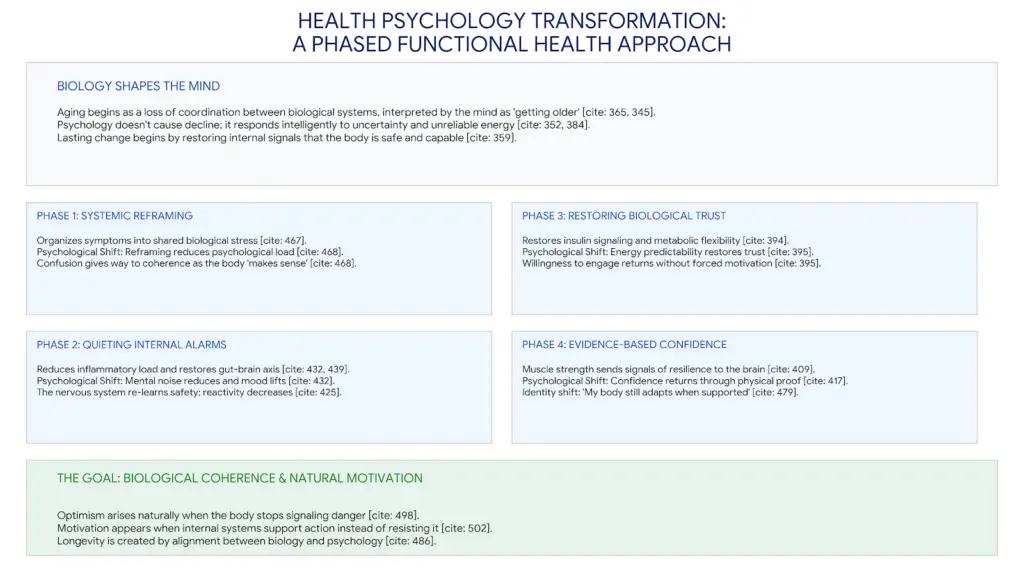
Functional health guidance rests on a simple but powerful principle: the body is adaptive, not fragile. Early decline is not failure. It is an intelligent response to repeated signals. Functional guidance works by changing those signals — consistently and in the correct biological sequence.
The process begins by organising symptoms into systems rather than treating them as isolated problems. Fatigue, poor sleep, weight gain, anxiety, low motivation, joint discomfort, and brain fog are understood as coordinated expressions of strained regulation. This clarity alone reduces fear. Confusion gives way to coherence. The body finally makes sense.
Next, biological safety is restored. Regular nourishment stabilises energy. Adequate protein supports repair, immunity, and signalling. Sleep timing re-establishes rhythm. Gentle movement re-engages circulation and muscle communication.
These steps are intentionally simple. They are not designed to impress. They are designed to calm. As threat signals reduce, stress hormones fall. Recovery improves. The body stops bracing.
Only then does capacity become trainable. Strength, endurance, and metabolic flexibility are rebuilt gradually. Each successful effort becomes proof. Proof updates identity. The internal narrative shifts from “my body is breaking down” to “my body adapts when supported.”
As biology stabilises, psychology transforms. Anxiety softens. Confidence returns. Behaviour becomes consistent rather than forced. Longevity emerges not from effort, but from alignment — between biology, nervous system, and daily life.
Functional health and longevity guidance helps maintain this alignment over time. It recognises that every individual brings a unique history, stress load, medication background, and adaptive capacity. Nothing is generic. Nothing is rushed. The framework becomes something the individual understands, works with, and sustains.
Closing Perspective
Aging is not the loss of youth. It is the loss of biological coherence. When systems communicate clearly again, the mind regains optimism and momentum. Motivation does not need to be manufactured. Confidence does not need to be trained. They return when the body once again signals safety, capacity, and recovery.
The future of longevity is not psychological willpower. It is functional restoration — allowing biology to lead, and psychology to follow.
References
- Bland, J.S. (2017). The Disease Delusion: Conquering the Causes of Chronic Illness for a Healthier, Longer, and Happier Life. New York: HarperWave.
- Institute for Functional Medicine (2020). Textbook of Functional Medicine. 2nd ed. Federal Way, WA: IFM.
- McEwen, B.S. (2007). Physiology and neurobiology of stress and adaptation. Physiological Reviews, 87(3), pp.873–904.
- Bickman, B. (2020). Why We Get Sick. Dallas: BenBella Books.
- Porges, S.W. (2011). The Polyvagal Theory. New York: W.W. Norton.
- Levine, P. (2010). In an Unspoken Voice. Berkeley: North Atlantic Books.
About Mathew Gomes
Functional Health, Nutrition & Longevity Coach
Mathew Gomes is a Functional Health, Nutrition & Longevity Coach helping busy professionals reverse early health decline before it becomes disease. Trained in Functional Nutrition Coaching (AAFH) and certified in executive coaching (ICF, EMCC), with an engineering background and MBA, he brings systems thinking and strategic clarity to health restoration.
Shaped by senior leadership experience and a personal health crisis, Mathew uses functional assessment and targeted testing to identify root causes and coordinate personalised nutrition, metabolic repair, strength training, nervous-system regulation, sleep and recovery. He works alongside doctors for diagnosis and medication while building resilient, sustainable health—so clients regain energy, focus and confidence without guesswork.
Disclaimer
This white paper is provided for educational and informational purposes only. It is not intended to diagnose, treat, cure, prevent, or provide medical advice for any disease or health condition.
The author is a Functional Health, Nutrition and Longevity Coach, not a medical doctor. The content presented reflects a functional, educational perspective on health, lifestyle, nutrition, and risk factors, and is designed to support informed self-care and productive conversations with qualified healthcare professionals. Nothing in this document should be interpreted as a substitute for medical advice, diagnosis, or treatment from a licensed physician or other qualified healthcare provider. Readers should not start, stop, or change any medication, supplement, or medical treatment without consulting their prescribing clinician.
Individual responses to nutrition, lifestyle, supplements, and coaching strategies vary. Any actions taken based on this information are done at the reader’s own discretion and responsibility. If you have a medical condition, are taking prescription medication, or have concerns about your health, you are advised to seek guidance from a licensed healthcare professional before making changes.