

A Health & Longevity Perspective for Modern Life
Executive Summary
Most people are told they are healthy as long as nothing is broken and their tests fall within range. Yet many capable, high-functioning adults feel persistently tired, foggy, inflamed, tense, or flat despite being reassured that everything is normal. This gap exists because health does not suddenly fail. It erodes quietly through years of biological adaptation to modern demand, disrupted rhythm, and cumulative load.
Functional health offers a clearer and more accurate definition of health. Health is the body’s capacity to communicate, adapt, and recover. When this capacity is strong, the body meets stress and returns to balance. When it weakens, the body compensates. Symptoms appear long before disease, signalling strain rather than breakdown.
This paper presents a functional definition of health, explains the body as an interconnected system, and outlines how diet, lifestyle, and environment shape genetic expression and long-term function. It reframes symptoms and disease as adaptive signals and shows how restoring biological order allows the body to move back toward optimal function—supporting performance, vitality, and longevity across decades of life.
A New Definition of Health
Health is not a static state and not a pass–fail outcome. From a functional perspective, health is functional capacity—the ability of the body’s systems to work together, adapt to demand, and recover efficiently over time. This view emerged because chronic disease did not follow the old model of “one cause, one disease, one drug.” Research in biology, genetics, systems science, and physiology showed that most modern health problems develop slowly, across multiple systems, long before diagnosis. Function changes first. Disease appears last.
When function is strong, energy is steady, sleep is restorative, thinking is clear, mood is resilient, digestion is reliable, and recovery from stress or exertion is predictable. Life feels spacious rather than effortful.
When function begins to decline, the body does not fail—it adapts. Stress hormones compensate, energy is borrowed, repair is postponed, and systems quietly shift priorities to survive. This adaptive phase can last for years and often feels like “normal life.” Disease is not the beginning of the problem; it is the point where compensation is no longer enough. Functional health focuses on this earlier phase—when systems are strained but still flexible—because this is where change is most effective, least invasive, and most sustainable.
The Body as an Interconnected System
The body operates as a living network, not a collection of isolated organs. Energy production influences brain function and mood. Stress regulation shapes digestion, immunity, and blood pressure. Sleep rhythm governs hormones, metabolism, and cellular repair. The gut influences inflammation, metabolic control, and emotional resilience.
Because systems are interdependent, symptoms rarely belong to just one place. Fatigue, weight gain, poor sleep, rising blood pressure, digestive discomfort, mood changes, and loss of resilience are not separate problems. They are coordinated signals of systems adapting to chronic load.
Functional health applies systems biology to real life. It looks for patterns, not labels, and restores function in the correct biological sequence—energy first, regulation next, repair last. This approach is grounded in research showing that when underlying function improves, symptoms resolve more predictably and long-term health trajectories change. Functional medicine is not an alternative to science. It is the application of modern biology to understand how the body actually behaves over time— and how health can be rebuilt before breakdown becomes disease.
The Seven Interconnected Systems
Functional health organises the body into seven core systems, each essential and interdependent.
- The metabolic and energy system governs how fuel is produced and used. Stable energy depends on responsive insulin signalling, healthy mitochondria, and adequate nutrients. When this system is strained, energy becomes erratic and inflammation rises.
- The cardiovascular and blood pressure system reflects vascular health and circulation. It depends on metabolic stability, low inflammatory load, and balanced nervous system tone. Vascular strain often begins long before disease is visible.
- The muscle, bone, and structural system provides strength, stability, and metabolic reserve. Muscle supports glucose control, hormone signalling, and long-term resilience. Structural decline accelerates when recovery and energy are insufficient.
- The brain, mood, and nervous system coordinates all systems. It governs stress response, sleep depth, emotional regulation, focus, and recovery. Persistent activation reduces the body’s capacity to repair.
- The gut and digestive system supplies raw materials to every other system. Efficient digestion, absorption, microbiome balance, and gut integrity are essential for energy, immunity, and hormonal balance.
- The immune and inflammatory system protects and repairs. When precise and well-regulated, inflammation resolves quickly. When chronically activated, it becomes background noise driving fatigue, pain, and metabolic disruption.
- The hormonal system provides rhythm and timing. Hormones coordinate sleep, appetite, stress response, repair, and reproduction. Hormonal disruption is often downstream of stress, metabolic instability, and circadian misalignment.
These systems operate in hierarchy. Nervous system regulation and metabolic stability form the foundation. Digestion supplies materials. Hormones and immunity respond to upstream conditions. When foundations are restored, higher-level systems recalibrate naturally.
Diet, Lifestyle, and Environment as Signals
From a functional view, daily inputs are not neutral. They are instructions.
Food provides signals that shape blood sugar, inflammation, repair, and energy availability. Regular, well-structured meals stabilise metabolism and reduce stress chemistry. Adequate protein preserves muscle and resilience. Micronutrients enable enzymatic repair. Inflammatory patterns amplify immune load.
Lifestyle shapes rhythm. Sleep timing sets hormonal order. Stress exposure alters nervous system tone. Movement rebuilds strength when paired with recovery. Daylight anchors circadian clocks. These signals accumulate daily, for better or worse.
Environment adds another layer. Light, noise, toxins, work demands, travel, and social connection all influence how genes are expressed and how systems behave.
The body continuously integrates these signals and adapts accordingly.
Genetic Expression, Symptoms, and Disease
Genes are not fixed instructions. They are responsive. They adjust activity based on the internal and external environment.
Symptoms are not errors. They are messages. Fatigue reflects energy strain. Brain fog reflects signalling inefficiency. Weight gain reflects altered fuel handling. Anxiety reflects nervous system overload. Disease represents long-term adaptation that has exceeded safe limits.
When inputs change consistently, genetic expression changes. When systems regain coherence, the body redirects toward repair and efficiency. This capacity does not disappear with age; it declines only when conditions prevent it.
How Functional Health Guidance Works
Functional health guidance is built on a simple, empowering principle: the body is adaptive, not fragile. Early changes in function are not signs of impending failure. They are intelligent responses to repeated signals.
Functional guidance helps the body receive clearer, more supportive signals—consistently and in the correct order—so it can move back toward optimal function.
The process begins by recognising patterns rather than reacting to isolated symptoms. Signals from across the body are organised into systems, revealing where adaptation is occurring and why. This replaces uncertainty with clarity and direction.
- Diet is used as biological instruction. Meals are structured to stabilise energy, support muscle, reduce inflammatory load, and provide the nutrients required for repair. Energy becomes reliable. Recovery improves. The body shifts from constant compensation toward restoration.
- Lifestyle is aligned with physiology. Sleep timing restores rhythm. Stress regulation calms the nervous system so repair can occur. Movement rebuilds strength and metabolic flexibility without exhausting recovery capacity. Daylight exposure resets internal clocks. These signals are precise and immediately recognised by the body.
- Environment is brought back into balance. Light exposure, work rhythm, toxin load, recovery space, and social connection are adjusted so the body no longer operates in constant defence. As background strain reduces, systems regain coordination.
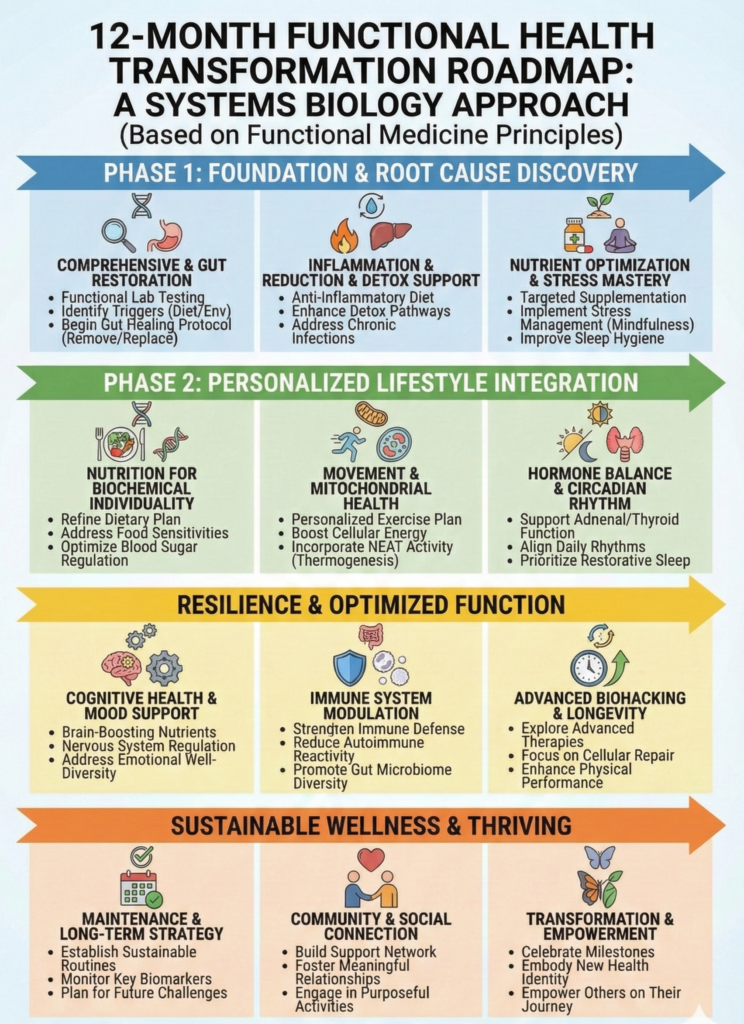
Functional guidance follows biological sequence. Safety and nervous system regulation come first. Energy and digestion stabilise next. Hormonal rhythm and immune balance recalibrate once foundations are secure. This sequencing makes progress steady and sustainable.
As systems regain flexibility, genetic expression shifts. Inflammation quiets. Energy production improves. Repair becomes efficient again. The body moves toward optimal function because the conditions for health are restored.
The results are practical and life-enhancing. Energy supports full workdays without reliance on stimulants. Focus holds under pressure. Sleep restores rather than merely pauses fatigue. Strength and confidence support movement, travel, and activity. Time with family and friends is enjoyed fully. Health becomes a foundation that supports ambition, relationships, and enjoyment of life at every age.
Functional health guidance makes this possible because it works with physiology, systems biology, and long-established biological principles. It replaces guesswork with structure, urgency with sequencing, and fear with understanding.
Final Thoughts
Health is not something that suddenly disappears. It is something that gradually loses order. Functional health restores that order by aligning daily signals with how the body is designed to function.
When diet, lifestyle, and environment support biology, the body’s natural capacity for adaptation and repair re-emerges. Energy steadies. Resilience returns. Longevity becomes a natural outcome rather than a constant concern.
Health becomes something you can build, protect, and sustain—so your body continues to support the life you want to live, at work, at home, and across all stages of life.
References
Bland, J.S. (2014) The Disease Delusion: Conquering the Causes of Chronic Illness for a Healthier, Longer and Happier Life. New York: HarperCollins.
Bland, J.S., Bralley, J.A. and Lord, R.S. (2017) Textbook of Functional Medicine. 2nd edn. Gig Harbor, WA: Institute for Functional Medicine.
Bickman, B. (2020) Why We Get Sick: The Hidden Epidemic at the Root of Most Chronic Disease. Dallas: BenBella Books.
Sapolsky, R.M. (2004) Why Zebras Don’t Get Ulcers. 3rd edn. New York: Henry Holt and Company.
Porges, S.W. (2011) The Polyvagal Theory. New York: W.W. Norton & Company.
Phinney, S.D. and Volek, J.S. (2011) The Art and Science of Low Carbohydrate Living. Miami, FL: Beyond Obesity LLC.
About Mathew Gomes
Functional Health, Nutrition & Longevity Coach
Mathew Gomes is a Functional Health, Nutrition & Longevity Coach helping busy professionals reverse early health decline before it becomes disease. Trained in Functional Nutrition Coaching (AAFH) and certified in executive coaching (ICF, EMCC), with an engineering background and MBA, he brings systems thinking and strategic clarity to health restoration.
Shaped by senior leadership experience and a personal health crisis, Mathew uses functional assessment and targeted testing to identify root causes and coordinate personalised nutrition, metabolic repair, strength training, nervous-system regulation, sleep and recovery. He works alongside doctors for diagnosis and medication while building resilient, sustainable health—so clients regain energy, focus and confidence without guesswork.
Disclaimer
This white paper is provided for educational and informational purposes only. It is not intended to diagnose, treat, cure, prevent, or provide medical advice for any disease or health condition.
The author is a Functional Health, Nutrition and Longevity Coach, not a medical doctor. The content presented reflects a functional, educational perspective on health, lifestyle, nutrition, and risk factors, and is designed to support informed self-care and productive conversations with qualified healthcare professionals. Nothing in this document should be interpreted as a substitute for medical advice, diagnosis, or treatment from a licensed physician or other qualified healthcare provider. Readers should not start, stop, or change any medication, supplement, or medical treatment without consulting their prescribing clinician.
Individual responses to nutrition, lifestyle, supplements, and coaching strategies vary. Any actions taken based on this information are done at the reader’s own discretion and responsibility. If you have a medical condition, are taking prescription medication, or have concerns about your health, you are advised to seek guidance from a licensed healthcare professional before making changes.