
A Biochemical Cycle That Shapes Energy, Detoxification, Brain Health, Immunity, and the Pace of Aging
Executive Summary
Methylation is one of the most fundamental regulatory systems in human biology. It operates quietly, continuously, and invisibly, yet it influences almost every aspect of health that people care about as they age: energy, mental clarity, emotional stability, detoxification, cardiovascular resilience, immune balance, and long-term disease risk.
At its core, methylation is a simple biochemical action—the transfer of a small chemical group from one molecule to another. But this small action acts like a master control signal. It determines which genes are turned on or off, how efficiently toxins are neutralised, how neurotransmitters are balanced, how hormones are processed, how cell membranes remain flexible, and how effectively cells repair themselves over time.
When methylation flows smoothly, the body maintains order. Repair keeps pace with damage. Stress is absorbed rather than amplified. Aging unfolds as a gradual, adaptive process. When methylation slows or becomes congested, decline begins silently. Regulation weakens long before symptoms appear. By the time disease is diagnosed, the underlying loss of biochemical flow has often been present for years.
This white paper explains methylation not as an abstract biochemical curiosity, but as a practical, actionable system that sits at the crossroads of longevity. It walks through the full methylation cycle—from methionine to SAM, SAH, and homocysteine—showing how nutrients, energy, stress, genetics, environment, and lifestyle shape its function. It also explains why modern life so commonly strains this system, and how a functional health approach restores flow by working with biology rather than forcing it.
Most importantly, this paper reframes methylation as a decision point, not a diagnosis. Addressed early, it becomes one of the most powerful levers for extending health span. Ignored, it quietly accelerates biological aging. Understanding this system allows intervention while change is still easy, adaptive, and protective.
Methylation as a Core Regulatory System
Methylation is not a niche pathway. It is one of the primary ways the body maintains internal order. Every second, in every cell, methylation reactions are directing traffic—telling DNA how to behave, guiding the liver in detoxification, shaping brain chemistry, modulating immune responses, and supporting cellular repair.
At the most basic level, methylation involves the transfer of a methyl group—a tiny chemical tag—from one molecule to another. Yet the consequences of this transfer are profound. These methyl groups act as instructions. They stabilise DNA, regulate gene expression, balance neurotransmitters, enable hormone metabolism, and allow toxins to be safely packaged for elimination.
When methylation is well supported, the body feels resilient. Energy is steady. Mood is adaptable. Recovery is efficient. When methylation falters, the body compensates quietly. Fatigue increases. Stress tolerance drops. Cognitive sharpness dulls. Inflammation becomes easier to trigger. These changes are often subtle and dismissed as normal aging or lifestyle strain, but they reflect a deeper shift in regulatory capacity.
This is why methylation sits at the heart of functional health and longevity. It determines whether biology remains flexible—or slowly drifts toward rigidity and disease.
The Methylation Cycle: Reading the Map Correctly
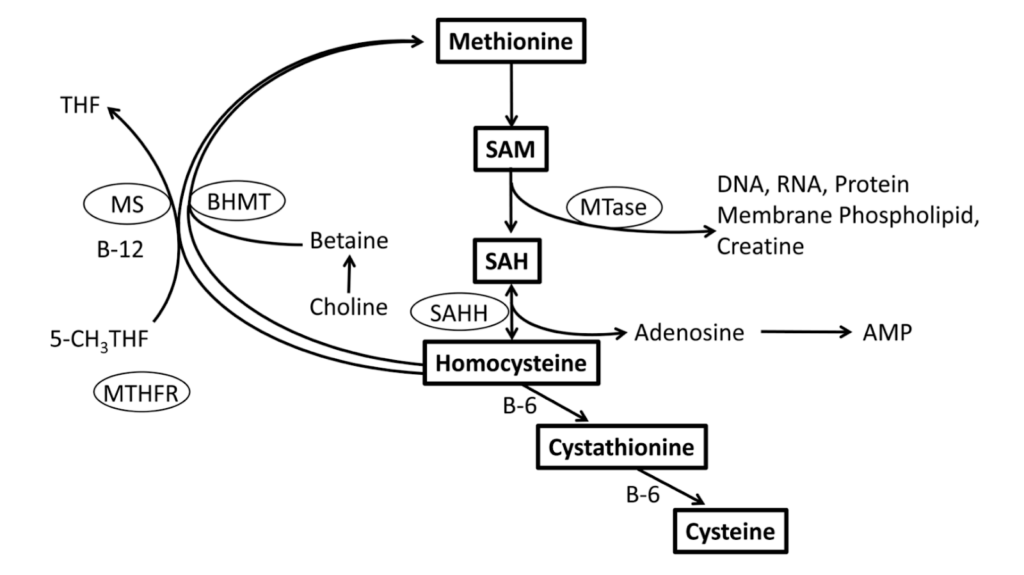
Everything in methylation begins with methionine, an essential amino acid obtained from protein in the diet. Methionine is not simply a structural building block. It is the ignition key for the entire cycle. Once inside the cell, methionine is converted into SAM, the body’s primary methyl donor. This conversion requires both magnesium and cellular energy in the form of ATP, immediately revealing an important truth: methylation depends not just on nutrients, but on energy availability and mineral sufficiency.
SAM, or S-adenosylmethionine, sits at the centre of the methylation map because it carries and donates methyl groups to hundreds of reactions throughout the body. Each donation is a regulatory act. SAM supports DNA stability, fine-tunes neurotransmitter balance, maintains cell membrane integrity, enables hormone processing, supports creatine production, and powers detoxification reactions in the liver.
Once SAM donates its methyl group, it becomes SAH, S-adenosylhomocysteine. SAH is not an inert by-product. It is a potent regulator. When SAH accumulates, it actively inhibits further methylation. In practical terms, this means that methylation capacity is determined not only by how much SAM is produced, but by how efficiently SAH is cleared.
SAH is then converted into homocysteine, a molecule that sits at the most sensitive junction in the entire system. Homocysteine is not meant to linger. In a healthy system, it is continuously recycled or safely diverted. When it accumulates, it becomes one of the earliest biochemical signs that methylation flow is slowing.
From homocysteine, the cycle offers two essential exit routes. One route recycles homocysteine back into methionine, preserving SAM availability and keeping the cycle moving. This pathway depends on active folate, vitamin B12, and coordinated enzyme function. The second route directs homocysteine downward into cystathionine and then cysteine, feeding glutathione production. This pathway depends on vitamin B6 and provides antioxidant protection and detoxification capacity.
When both exits are open and supported, homocysteine remains low, SAH clears efficiently, and methylation remains robust. When even one exit narrows, congestion builds and regulation begins to weaken.
SAM: The Molecule That Holds the System Together
SAM is the fuel that keeps methylation running. Every major regulatory system in the body depends on its availability. When SAM levels are adequate, DNA regulation remains precise, neurotransmitters stay balanced, detoxification proceeds efficiently, immune responses remain proportionate, and mitochondrial energy production is protected.
When SAM declines, the body does not simply slow one process. It begins rationing methylation across the entire system. Short-term survival is prioritised over long-term repair. DNA regulation becomes less stable. Neurotransmitter turnover becomes erratic. Detoxification capacity shrinks. Inflammation becomes harder to resolve.
Producing SAM requires methionine, magnesium, and ATP. This explains why chronic stress, poor sleep, inflammation, unstable blood sugar, or nutrient depletion so commonly impair methylation even when diet appears “adequate.” The system is not broken; it is overwhelmed.
Equally important is the balance between SAM and SAH. When SAH accumulates, methylation is inhibited regardless of SAM production. This compressed SAM-to-SAH ratio is one of the clearest signals that regulatory capacity is declining.
Homocysteine: The Junction Between Repair and Damage
Homocysteine represents a critical decision point. When methylation flow is smooth, homocysteine is transient and harmless. When flow slows, homocysteine accumulates and begins exerting pressure across multiple systems.
Elevated homocysteine reflects impaired recycling, reduced detoxification capacity, and increasing oxidative stress. At the vascular level, it irritates the lining of blood vessels and reduces flexibility. In the brain, it reflects reduced neurotransmitter regulation and stress resilience. At the cellular level, it signals rising oxidative damage and declining repair.
Importantly, elevated homocysteine almost always travels with rising SAH, reinforcing a feedback loop that further suppresses methylation. This is why homocysteine is not just a cardiovascular marker, but a whole-system indicator of declining regulatory flow.
Recycling Homocysteine: Restoring Continuity
The first way the body restores balance is by recycling homocysteine back into methionine. This pathway depends on active folate and bioavailable vitamin B12 working in precise coordination. When this loop functions well, homocysteine clears, SAM is replenished, and methylation becomes sustainable rather than fragile.
Form matters more than quantity. Folate must be in its active state. B12 must be functional inside the cell. Genetic efficiency, digestion, inflammation, and oxidative stress all influence whether this pathway works smoothly.
Restoring this loop is not about chasing numbers. It is about restoring continuity—allowing the body to regenerate its own regulatory chemistry without draining other systems.
The Second Exit: Glutathione and Resilience
The second exit converts homocysteine into cysteine and ultimately glutathione, the body’s primary intracellular antioxidant. This pathway provides protection. It lowers homocysteine while strengthening detoxification, immune balance, mitochondrial resilience, and recovery from stress.
This route becomes increasingly important under modern environmental load. Toxins, inflammation, metabolic stress, and psychological pressure all generate oxidative stress. Glutathione absorbs this burden, allowing repair to continue.
When this pathway is under-supported, detoxification slows, inflammation lingers, and aging accelerates at the cellular level. Supporting recycling without supporting glutathione creates a brittle system. Supporting both creates resilience.
Why Methylation Commonly Breaks Down
Methylation does not fail suddenly. It erodes gradually as energy demand rises, nutrient reserves fall, environmental load increases, inflammation persists, and genetic inefficiencies are exposed.
Chronic stress diverts ATP away from regulation. Magnesium and B vitamins are depleted under pressure. Environmental toxins consume methyl groups and glutathione. Inflammation suppresses enzymes. The body compensates—until it cannot.
The danger lies in silence. Routine tests remain normal while regulatory capacity shrinks. Symptoms are attributed to age or workload. The system drifts toward disease long before diagnosis appears.
From Imbalance to Disease
Unchecked methylation breakdown affects every major system. Brain chemistry becomes less stable. Cardiovascular resilience declines. Immune regulation weakens. Detoxification slows. DNA regulation becomes erratic. Mitochondrial efficiency falls.
This explains why chronic diseases cluster together. They share a common upstream driver: loss of regulatory chemistry.
Why This Is Often Missed—and Why Guidance Matters
Conventional medicine excels at diagnosing disease once damage is visible. Methylation dysfunction occurs far upstream, at the level of regulation rather than pathology. It requires systems interpretation, not isolated markers.
A functional health and longevity approach reads methylation as a dynamic system shaped by diet, digestion, energy, stress, environment, and genetics. Intervention focuses on restoring flow, reopening exits, reducing unnecessary demand, and sequencing support correctly.
When guided carefully, the body reorganises itself. Repair regains priority. Resilience returns. Aging slows—not because time stops, but because damage no longer outpaces repair.
Methylation as a Longevity Lever
Methylation quietly determines whether the body moves toward resilience or decline. The warning signals appear early, while recovery is still possible. Addressed at the right time and in the right order, methylation becomes one of the most powerful tools for extending health span.
This is not about optimisation for its own sake. It is about protecting energy, clarity, independence, and quality of life over decades. Methylation is not a trend. It is a biological constant—and one of the most decisive levers available for shaping the future of health.
References
James, S.J. et al. (2002) ‘Elevation in S-adenosylhomocysteine and DNA hypomethylation: potential epigenetic mechanism for homocysteine-related pathology’, Journal of Nutrition, 132(8), pp. 2361S–2366S.
Yi, P. et al. (2000) ‘Increase in plasma homocysteine associated with parallel increase in plasma S-adenosylhomocysteine and lymphocyte DNA hypomethylation’, Journal of Biological Chemistry, 275(38), pp. 29318–29323.
Lu, S.C. (2009) ‘Regulation of glutathione synthesis’, Molecular Aspects of Medicine, 30(1–2), pp. 42–59.
James, S.J. et al. (2008) ‘Abnormal transmethylation/transsulfuration metabolism and DNA hypomethylation’, Journal of Autism and Developmental Disorders, 38(10), pp. 1966–1975.
Doctor’s Data, Inc. (2025) Plasma Methylation Profile Interpretation Guide.
About Mathew Gomes
Functional Health, Nutrition & Longevity Coach
Mathew Gomes is a Functional Health, Nutrition & Longevity Coach helping busy professionals reverse early health decline before it becomes disease. Trained in Functional Nutrition Coaching (AAFH) and certified in executive coaching (ICF, EMCC), with an engineering background and MBA, he brings systems thinking and strategic clarity to health restoration.
Shaped by senior leadership experience and a personal health crisis, Mathew uses functional assessment and targeted testing to identify root causes and coordinate personalised nutrition, metabolic repair, strength training, nervous-system regulation, sleep and recovery. He works alongside doctors for diagnosis and medication while building resilient, sustainable health—so clients regain energy, focus and confidence without guesswork.
Disclaimer
This white paper is provided for educational and informational purposes only. It is not intended to diagnose, treat, cure, prevent, or provide medical advice for any disease or health condition.
The author is a Functional Health, Nutrition and Longevity Coach, not a medical doctor. The content presented reflects a functional, educational perspective on health, lifestyle, nutrition, and risk factors, and is designed to support informed self-care and productive conversations with qualified healthcare professionals. Nothing in this document should be interpreted as a substitute for medical advice, diagnosis, or treatment from a licensed physician or other qualified healthcare provider. Readers should not start, stop, or change any medication, supplement, or medical treatment without consulting their prescribing clinician.
Individual responses to nutrition, lifestyle, supplements, and coaching strategies vary. Any actions taken based on this information are done at the reader’s own discretion and responsibility. If you have a medical condition, are taking prescription medication, or have concerns about your health, you are advised to seek guidance from a licensed healthcare professional before making changes.